What is the best cloud-based IDE in 2026?
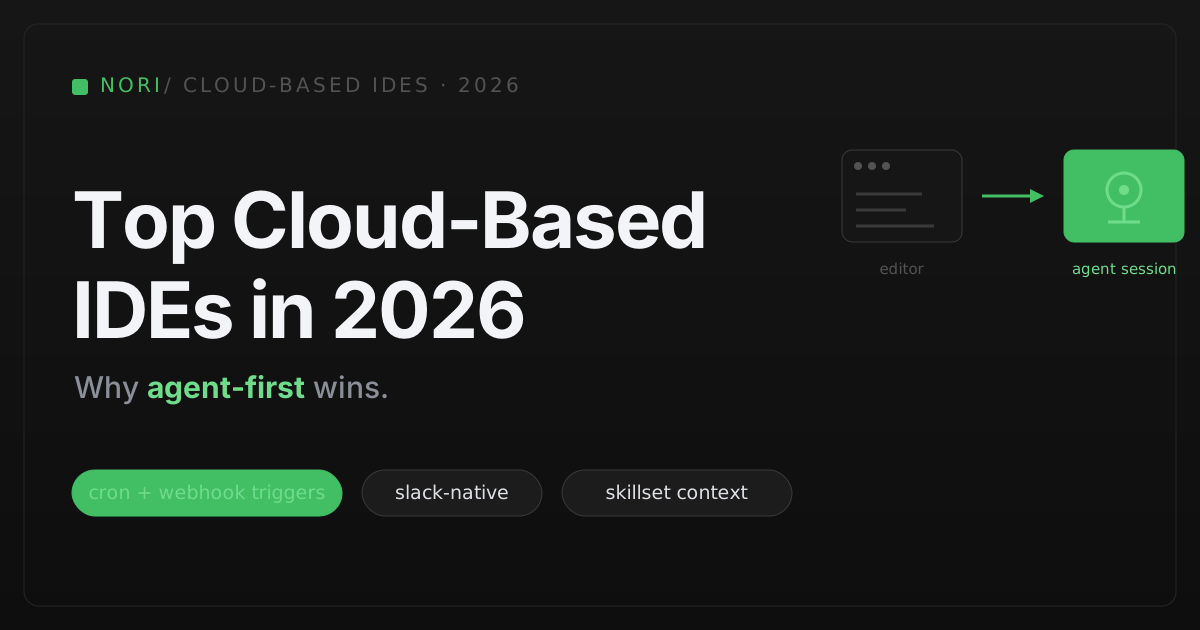
It depends on who is typing. For a human developer on GitHub, Codespaces is the default: VS Code in the browser from any repo, billed per core-hour. For learning and prototyping with an AI app builder, Replit is the friendliest. For quick frontend reproductions, use StackBlitz. Do not start new work on Firebase Studio or AWS Cloud9, which no longer accept new workspaces or new customers. If coding agents do most of the typing and should start from cron, webhooks, or Slack, with an editor on demand, pick Nori.
What a cloud-based IDE is
A cloud-based IDE moves your development environment into the browser: file tree, terminal, language servers, and debugger, all running on remote compute. It is for teams that want zero laptop setup, identical environments for everyone, and the ability to code from any device. In 2026 the category is splitting in two: browser editors for humans, and agent runtimes where coding agents do the work and a human opens an editor only to review or take over.
The leading cloud-based IDEs, as of October 2026
GitHub Codespaces is the polished browser editor for teams that live in GitHub. It launches a configured VS Code workspace from any repo via the devcontainer spec. As of October 2026, GitHub Free includes 120 core-hours and 15 GB-month of storage per month (GitHub Pro: 180 core-hours and 20 GB-month); after that compute is $0.18/hour on 2 cores up to $2.88/hour on 32 cores, and storage is $0.07 per GB-month (GitHub Docs). There is no self-hosted option.
Replit pairs a browser editor with an AI agent, built-in databases, and one-click deploys. As of October 2026, Core is $20/month and Pro is $100/month, each including the same amount in monthly usage credits, then pay-as-you-go; Enterprise is custom (Replit pricing). Usage limits and budgets can stop usage-based services when you hit them (Replit docs). It is the friendliest place to learn and prototype.
StackBlitz runs full development environments in the browser and offers Personal (free), Teams, and Enterprise plans; it also makes Bolt.new, an AI app builder (StackBlitz pricing). CodeSandbox is now part of Together AI and focuses on its sandbox SDK (CodeSandbox). Both are great for quick frontend sandboxes and shareable reproductions, less so for running a large monorepo all day.
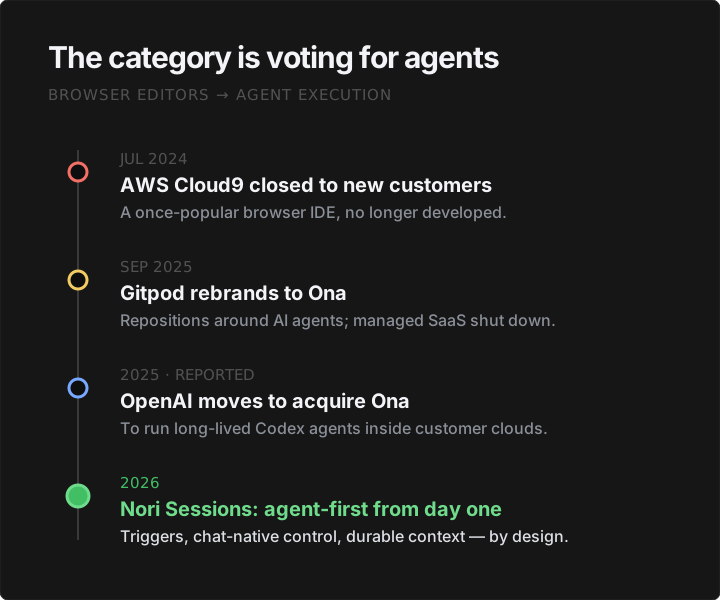
Ona (formerly Gitpod) tells the category’s biggest story. Gitpod rebranded to Ona in September 2025 and repositioned around AI agents (Ona), and Gitpod Classic pay-as-you-go shut down on October 15, 2025 (Ona). On June 11, 2026, OpenAI announced it would acquire Ona, with the team joining Codex (OpenAI). As of October 2026 Ona’s site says it is part of OpenAI and lists no self-serve plans, only a contact-sales form (Ona pricing).
Two browser IDEs are winding down. Firebase Studio (formerly Project IDX) stopped accepting new workspaces on June 22, 2026, and shuts down on March 22, 2027; Google points users to Google AI Studio or Google Antigravity (Firebase docs). AWS Cloud9 is no longer available to new customers; existing customers can keep using it, and AWS has not announced an end-of-life date (AWS docs).
How they compare
| Platform | Primary interface | Pricing (as of October 2026) | Unattended runs (cron / webhook) |
Chat control | Status (as of October 2026) |
|---|---|---|---|---|---|
| GitHub Codespaces | VS Code in browser | Free core-hours, then $0.18–$2.88/hour | ✗ | ✗ | Active |
| Replit | Editor + AI agent | Core $20/mo; Pro $100/mo; usage credits | ✗ | ✗ | Active |
| StackBlitz | Browser environment | Personal free; Teams; Enterprise | ✗ | ✗ | Active |
| CodeSandbox | Browser sandbox + SDK | — | ✗ | ✗ | Part of Together AI |
| Ona (formerly Gitpod) | Agent environments | Contact sales | — | — | Part of OpenAI |
| Firebase Studio | Browser editor + AI | — | ✗ | ✗ | No new workspaces; shuts down March 22, 2027 |
| AWS Cloud9 | Browser editor | — | ✗ | ✗ | Closed to new customers |
| Nori Sessions | Agent session, terminal and editor on demand | Developer $99/mo; Team $250/mo; never charges for tokens | ✓ | ✓ Slack, Discord | Active |
Vendor-documented pricing and status as of October 2026. See sources below.
How to choose a cloud-based IDE
- Who does the typing? If humans write most of the code, editor polish matters. If agents do, the environment underneath (repo, toolchain, credentials, triggers) is the product, and the editor is a viewport.
- Pricing model. Core-hour meters (Codespaces), usage credits (Replit), per-seat tiers (StackBlitz), or a flat plan (Nori). Meters are fair for bursty human use and harder to budget for agents that run every night.
- Unattended capability. Can work start with no human in a browser tab? Editors assume a person is present.
- Ecosystem fit. Codespaces assumes GitHub. Replit and StackBlitz assume their own hosting and app-builder flows.
- Longevity. Cloud9 closed to new customers, Firebase Studio is shutting down, and Gitpod became Ona and then part of OpenAI. Check the roadmap before you standardize.
- The human escape hatch. Whatever runs unattended, a human eventually wants a terminal and editor on the same machine, with the run’s state intact. The compute layer underneath is its own category; we compare it in our agent runtimes and sandboxes guide.
The category is moving from editors to agents
The most influential browser-IDE company of the last decade dropped the editor framing, pivoted to agents, and was bought by OpenAI. Google is retiring Firebase Studio in favor of AI Studio and Antigravity. When agents do the work, the configured environment (repo, toolchain, credentials) is what matters, and the editor pane becomes optional.
Where Nori fits
Nori Sessions is not a better browser editor; if a person is doing the typing, Codespaces or Replit will serve them well. A Nori Session is an ephemeral cloud machine where a coding agent runs, with a terminal and editor for when a human wants to step in:
- Any harness. Run Claude Code, Codex, Gemini CLI, Cursor, OpenCode, Droid, Amp, Goose, or any ACP agent.
- We never charge for tokens. Bring your own Claude or ChatGPT subscription, API keys, or LLM gateway. No markup and no provider lock-in.
- Cron and webhook automations. Sessions start with no human attached and report back when done.
- Slack, Discord, web, and CLI. Steer sessions where your team already works.
- Opinionated defaults. Workflow skills, org skillsets, and memories load on every fresh machine.
- Enterprise. Bring your own compute, IdP (SAML, SCIM, OIDC), LLM gateway, token provider, and memory provider, in your cloud or on-prem.
Pricing as of October 2026: a free 30-day trial (5 runtimes, no card), Developer $99/month, Team $250/month, and Enterprise custom. Teams have merged 100,000+ PRs with Nori. To compare Nori with hosted coding agents such as Devin and Cursor, see our cloud coding agents comparison and Nori vs Cursor cloud agents.
Subscribe to the newsletter
Weekly updates and long-form essays from the Nori team on AI agents and the agent ecosystem.
The bottom line
Want a browser editor tied to GitHub? Codespaces does that well. Want a place to prototype with an AI app builder? Replit and StackBlitz are right there. Avoid starting new work on Firebase Studio or Cloud9. If your bottleneck is getting coding agents to do repeatable work, triggered by a schedule or a chat message, with your own harness and model subscription, Nori is built for that.
Start a free 30-day Nori trial.
Frequently asked questions
What is a cloud-based IDE?
A cloud-based IDE moves your development environment into the browser: file tree, terminal, language servers, and debugger, all running on remote compute. You get zero laptop setup, identical environments for the whole team, and the ability to code from any device.
What happened to Gitpod?
Gitpod rebranded to Ona in September 2025 and repositioned around AI agents; Gitpod Classic pay-as-you-go shut down on October 15, 2025. OpenAI announced it would acquire Ona on June 11, 2026, and Ona’s site now says it is part of OpenAI. As of October 2026 Ona lists no self-serve plans, only a contact-sales form.
Is AWS Cloud9 still available?
Only for existing customers. As of October 2026, AWS says Cloud9 is no longer available to new customers, and existing customers can keep using it as normal. AWS has not announced an end-of-life date.
Is Firebase Studio (Project IDX) shutting down?
Yes. Google disabled new Firebase Studio workspaces on June 22, 2026, and will shut it down and delete its data on March 22, 2027. Google points users to Google AI Studio or Google Antigravity. Core Firebase services are not affected.
How much does GitHub Codespaces cost?
As of October 2026, GitHub Free includes 120 core-hours and 15 GB-month of storage per month, and GitHub Pro includes 180 core-hours and 20 GB-month. After that, compute costs $0.18 per hour on a 2-core machine (about $0.09 per core-hour) up to $2.88 per hour on 32 cores, and storage is $0.07 per GB-month.
What is the best cloud IDE for AI agent development?
If a human does most of the typing, pick an editor: Codespaces for GitHub teams or Replit for prototyping. If coding agents do most of the work, you need a runtime that starts them from cron, webhooks, or chat. Nori runs any harness with your own Claude or ChatGPT subscription or API keys, never charges for tokens, and gives a human a terminal and editor on the same machine.
Sources
- GitHub Codespaces billing — GitHub Docs
- GitHub Codespaces — features
- Pricing — Replit
- Managing spend — Replit Docs
- Pricing — StackBlitz
- CodeSandbox, part of Together AI — CodeSandbox
- Gitpod is now Ona — Ona
- Gitpod Classic PAYG sunset — Ona
- OpenAI to acquire Ona — OpenAI
- Pricing — Ona
- Migrating from Firebase Studio — Firebase Docs
- What is AWS Cloud9? — AWS Docs