What is the best AI agent sandbox or runtime in 2026?
It depends on what you are building. If your product runs untrusted AI-generated code, use a sandbox API: E2B for Firecracker microVMs with a bring-your-own-cloud option, Modal when the workload needs GPUs, Vercel Sandbox if you already deploy on Vercel, Cloudflare if you build on Workers, and Daytona for fast container sandboxes. If you want your team’s coding agents, such as Claude Code or Codex, to run on a schedule or from Slack without building that layer yourself, use an agent runtime such as Nori.
Sandboxes and runtimes, defined
An AI agent sandbox is an isolated, disposable compute environment, such as a Firecracker microVM, a gVisor sandbox, or a container, where an agent can run code a model just wrote without risking the host or your network. Developers building AI products call sandboxes through an API or SDK. An AI coding agent runtime sits one layer up: the sandbox plus the agent harness, repo and credential wiring, model access, triggers, chat control, and org context that a coding agent needs to finish a task for a team. Sandboxes are raw material for builders; runtimes are for engineering teams that want agents doing work.
The sandbox providers, as of October 2026
E2B runs each sandbox in a hardware-isolated Firecracker microVM (E2B). As of October 2026, Hobby is free with a $100 one-time credit and 1-hour sessions; Pro is $150/month plus usage with 24-hour sessions; Enterprise is custom with a $3,000/month minimum and a bring-your-own-cloud data plane on AWS, GCP, or Azure. CPU is $0.000014 per vCPU-second, about $0.05 per vCPU-hour (E2B pricing).
Daytona runs sandboxes as Linux containers by default, with full VM sandboxes as an option, and claims sub-90ms creation (Daytona docs). As of October 2026 it charges $0.0504 per vCPU-hour and $0.0162 per GiB-hour of memory, billed per second, with $200 in free compute (Daytona pricing). Its open-source repository is archived; core development moved to a private codebase in June 2026 (GitHub).
Modal is the pick when the workload touches a GPU. Sandboxes use gVisor by default, and since October 1, 2026, runtime="vm" gives each sandbox its own kernel on Cloud Hypervisor at the same price; sandboxes time out after at most 24 hours (Modal docs, Modal blog). As of October 2026, sandbox CPU is about $0.142 per physical core-hour (one core is two vCPUs), H100s are about $3.95/hour, Starter is free with $30/month in credits, and Team is $250/month with $100 in credits (Modal pricing).
Vercel Sandbox runs Firecracker microVMs with a dedicated kernel (Vercel docs). As of October 2026 it bills $0.128 per active CPU hour (I/O wait is not billed) and $0.0212 per GB-hour of memory, and sessions run up to 45 minutes on Hobby and 24 hours on Pro and Enterprise (Vercel pricing).
Cloudflare Sandbox SDK became generally available with Cloudflare Containers on April 13, 2026, and requires the Workers Paid plan. It gives you a TypeScript API for commands, files, and services, plus preview URLs, code interpreters, PTY terminals, and backup and restore (Cloudflare changelog). As of October 2026, Containers bill $0.000020 per active vCPU-second, with monthly allowances included (Cloudflare pricing).
How they compare
| Platform | What you get | Isolation | Pricing (as of October 2026) | Max session | Agents, triggers, chat built in |
|---|---|---|---|---|---|
| E2B | Sandbox API | Firecracker microVM | ~$0.05/vCPU-hour; Pro $150/mo + usage | 1h Hobby; 24h Pro | ✗ |
| Daytona | Sandbox API | Container (default) or VM | $0.0504/vCPU-hour + memory | Not published | ✗ |
| Modal | Serverless compute + sandboxes | gVisor (default) or VM | ~$0.142/core-hour sandbox CPU; H100 ~$3.95/hour | 24h | ✗ |
| Vercel Sandbox | Sandbox API | Firecracker microVM | $0.128/active CPU hour + memory | 45 min Hobby; 24h Pro | ✗ |
| Cloudflare Sandbox SDK | Sandbox SDK on Workers | Containers | Active vCPU-seconds; Workers Paid | Not published | ✗ |
| Nori Sessions | Coding agent runtime | Ephemeral cloud machines | Developer $99/mo; Team $250/mo; never charges for tokens | — | ✓ |
Vendor-documented capabilities and pricing as of October 2026; hourly rates converted from per-second prices. See sources below.
How to choose an agent sandbox or runtime
- Isolation model. Firecracker (E2B, Vercel) and VM sandboxes (Modal, Daytona) give each sandbox its own kernel; gVisor and containers trade some isolation for density and speed. Match the boundary to how untrusted the code is.
- Session lifetime. A refactor can run for hours. Caps like E2B Hobby’s 1 hour or Vercel Hobby’s 45 minutes become product constraints.
- GPU needs. If the agent trains or serves models, Modal is the natural fit.
- Where it runs. E2B Enterprise offers a data plane in your own cloud; check this early if you are regulated.
- What ships above the machine. Sandbox APIs leave the agent harness, model credentials, scheduler, and notifications to you.
- Vendor stability. Daytona closed its source in 2026. Read the roadmap and the license before you build on a platform.
Where Nori fits
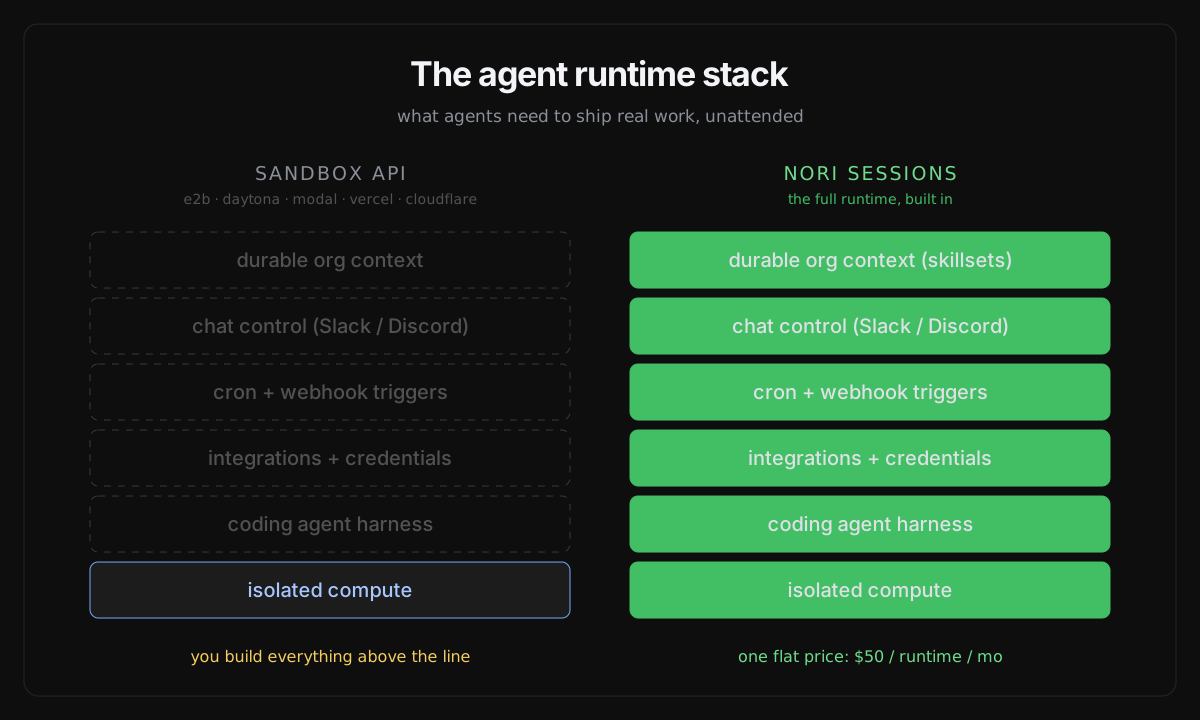
Nori is not a sandbox API, and if you are building a product that executes user code, one of the providers above is the better choice. Nori Sessions is for engineering teams that want their coding agents doing work on ephemeral cloud machines without building the layers above the sandbox:
- Any harness. Run Claude Code, Codex, Gemini CLI, Cursor, OpenCode, Droid, Amp, Goose, or any ACP agent.
- We never charge for tokens. Bring your own Claude or ChatGPT subscription, API keys, or LLM gateway. No markup and no provider lock-in.
- Cron and webhook automations. Sessions start with no human attached and report back when done.
- Slack, Discord, web, and CLI. Steer sessions where your team works, and open a terminal and editor on the same machine when needed.
- Opinionated defaults. Workflow skills, org skillsets, and memories load on every fresh machine.
- Enterprise. Bring your own compute, IdP (SAML, SCIM, OIDC), LLM gateway, token provider, and memory provider, in your cloud or on-prem.
Pricing as of October 2026: a free 30-day trial (5 runtimes, no card), Developer $99/month, Team $250/month, and Enterprise custom. Teams have merged 100,000+ PRs with Nori. To compare Nori with other hosted coding agents rather than sandboxes, see our cloud coding agents comparison or Nori vs OpenHands.
Subscribe to the newsletter
Weekly updates and long-form essays from the Nori team on AI agents and the agent ecosystem.
The bottom line
If you are building a product that executes untrusted AI-generated code, the sandbox APIs are excellent raw material: E2B for microVM isolation and a bring-your-own-cloud path, Modal for GPUs, Vercel or Cloudflare if you already build on those platforms, and Daytona for fast container sandboxes. If what you want is your team’s coding agents working on a schedule or from chat, with your own harness and model subscription, use a runtime. Nori is built for that.
Start a free 30-day Nori trial.
Frequently asked questions
What is an AI agent sandbox?
An AI agent sandbox is an isolated, disposable compute environment, such as a Firecracker microVM, a gVisor sandbox, or a container, where an AI agent can run untrusted, model-generated code without putting the host or your infrastructure at risk. E2B, Daytona, Modal, Vercel, and Cloudflare offer them through APIs and SDKs.
What is the difference between an agent sandbox and an agent runtime?
A sandbox is isolated compute that boots fast and runs untrusted code. A runtime is everything a coding agent needs to do a job: the sandbox plus the agent harness, repo and credential wiring, model access, triggers such as cron and webhooks, chat control, and org context. Sandbox APIs leave those layers to you; an agent runtime such as Nori ships them.
Which AI agent sandbox starts the fastest?
As of October 2026, Daytona claims sub-90ms sandbox creation, the fastest published claim we found; it does not publish its method. Startup times change often, so measure with your own image before choosing on speed alone.
How much do AI agent sandboxes cost?
As of October 2026, most sandboxes are metered per second. E2B and Daytona both charge about $0.05 per vCPU-hour plus memory; E2B Pro is $150/month plus usage. Modal sandbox CPU is about $0.142 per core-hour. Vercel Sandbox is $0.128 per active CPU hour. Cloudflare Containers bill active vCPU-seconds on Workers Paid. Nori is Developer $99/month or Team $250/month and never charges for tokens.
How long can an agent sandbox run?
As of October 2026: E2B allows 1 hour on Hobby and 24 hours on Pro; Vercel Sandbox allows 45 minutes on Hobby and 24 hours on Pro and Enterprise; Modal sandboxes time out after at most 24 hours.
Can I run coding agents unattended on these platforms?
On sandbox APIs, unattended operation is your job: you build the scheduler, install the agent, and wire the notifications. Nori Sessions has cron and webhook automations built in and runs any harness, so sessions start, do the work, and report back to Slack or Discord with no human attached.
Sources
- E2B
- Pricing — E2B
- Pricing — Daytona
- Sandboxes — Daytona Docs
- daytonaio/daytona (archived) — GitHub
- Sandboxes — Modal Docs
- VM Sandboxes — Modal blog
- Pricing — Modal
- Sandbox concepts — Vercel Docs
- Sandbox pricing and limits — Vercel Docs
- Containers and Sandboxes GA — Cloudflare changelog
- Sandbox SDK overview — Cloudflare Docs
- Containers pricing — Cloudflare Docs