What is the best remote ephemeral dev sandbox in 2026?
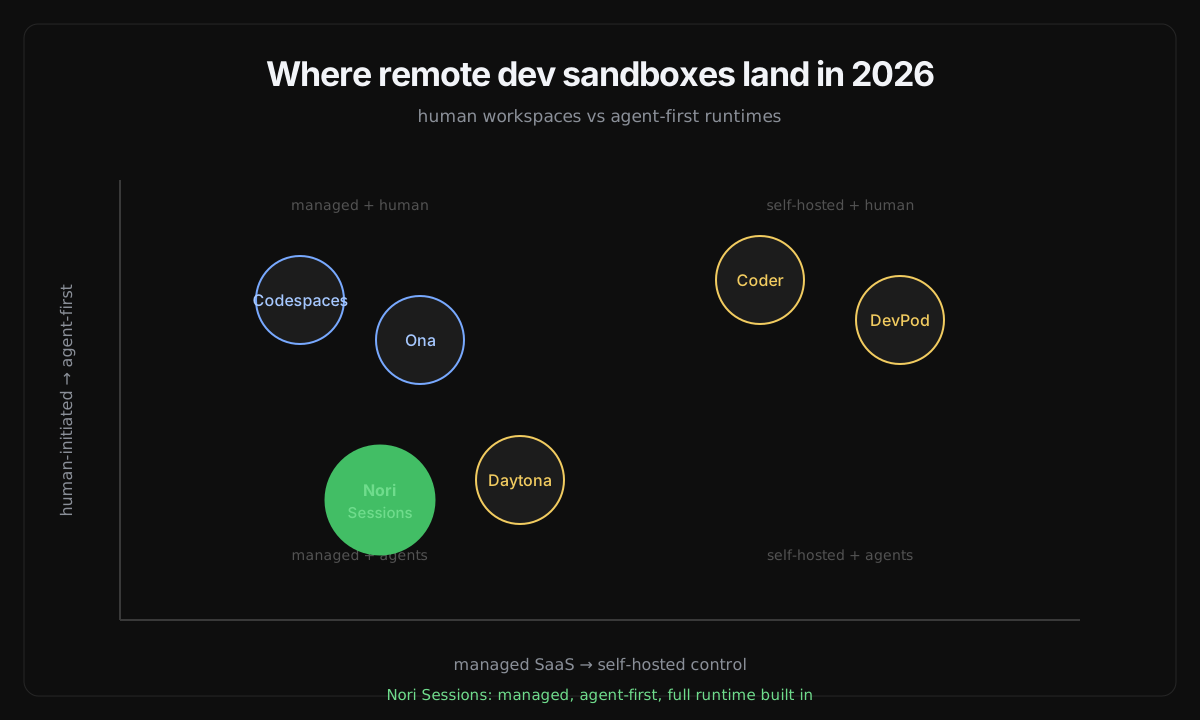
It depends on who uses the machine. For human developers on GitHub, Codespaces is the default: one click from any repo, billed per core-hour. Platform teams that must self-host should pick Coder, which now also runs agents from its control plane. If you are building a product that creates sandboxes programmatically for AI agents, Daytona is a fast metered API. Pick Nori when the main user is a coding agent that should start from cron, a webhook, or Slack, using any harness and your own model subscription.
What a remote ephemeral dev sandbox is
A remote ephemeral dev sandbox is a short-lived cloud machine created on demand from a repository or template, preloaded with the project’s toolchain, and deleted when the work is done. Teams use them to keep source code and credentials off laptops, give every developer the same environment, and isolate untrusted or AI-generated code from production networks. In 2026 the user of that machine is increasingly a coding agent rather than a person, which changes what matters: how the machine starts, what is preinstalled, and who steers it.
The remote sandbox providers, as of October 2026
GitHub Codespaces is the path of least resistance for GitHub teams: an environment from any repository via the devcontainer spec, in the browser or a desktop IDE. As of October 2026, compute costs $0.18/hour on 2 cores up to $2.88/hour on 32 cores, storage is $0.07 per GB-month, and GitHub Free includes 120 core-hours a month (180 on GitHub Pro) (GitHub Docs). It is built for a developer opening an environment, not for agents started from a scheduler.
Coder is the self-hosted standard: Terraform-provisioned workspaces on any cloud, for platform teams that need full control over where code lives. Its agent story changed in September 2026. Coder Agents became generally available in v2.37 and runs the agent loop in the Coder control plane; Coder Tasks, deprecated in v2.34, is removed in v2.37 and its API is replaced by a Chats API that is not a drop-in swap (Coder changelog, Coder docs). Plans as of October 2026: Community is free, Premium is billed per user annually with no public price, and AI Premium (custom) adds unlimited agents and headless agents via API (Coder pricing).
Daytona now markets itself as sandbox infrastructure for AI agents rather than human dev environments. Sandboxes run as Linux containers by default, with full VM sandboxes as an option, and Daytona claims sub-90ms creation (Daytona docs). As of October 2026 it bills per second: $0.0504 per vCPU-hour and $0.0162 per GiB-hour of memory, with $200 in free compute (Daytona pricing). The open-source repository is archived; its README says core development moved to a private codebase in June 2026 (GitHub). We compare it with other agent sandbox APIs in our agent runtimes and sandboxes guide.
Ona (formerly Gitpod) is now part of OpenAI. OpenAI announced the acquisition on June 11, 2026, with the Ona team joining the Codex team (OpenAI). Ona still describes running “Ona, Codex, and other agents” in its cloud or your VPC, but as of October 2026 its pricing page lists no self-serve plans, only a contact-sales form (Ona, Ona pricing). Gitpod Classic pay-as-you-go shut down on October 15, 2025 (Ona).
DevPod is a free, client-only, MPL-2.0 tool that creates devcontainer.json workspaces on Docker, Kubernetes, SSH hosts, or cloud VMs, with no server to run (GitHub). Treat it as lightly maintained: as of October 2026 the latest release is v0.6.15 from March 2025.
How they compare
| Platform | Built for | Deployment | Pricing (as of October 2026) | Status (as of October 2026) |
|---|---|---|---|---|
| GitHub Codespaces | Human developers on GitHub | Managed (GitHub) | $0.18–$2.88/hour by core count; free monthly core-hours | Active |
| Coder | Platform teams; Coder Agents | Self-hosted | Community free; Premium and AI Premium by quote | Tasks removed in v2.37; replaced by Coder Agents |
| Daytona | Programmatic agent sandboxes | Managed cloud | $0.0504/vCPU-hour + memory, per second | Open-source repo archived; development private since June 2026 |
| Ona | Agent environments | Ona cloud or your VPC | Contact sales; no public prices | Part of OpenAI |
| DevPod | Individuals and small teams | Client + your cloud | Free client; you pay your cloud | No release since March 2025 |
| Nori Sessions | Coding agents started from cron, webhooks, or chat | Managed; Enterprise on your compute | Developer $99/mo; Team $250/mo; never charges for tokens | Active |
Vendor-documented capabilities, pricing, and status as of October 2026. See sources below.
How to choose a remote dev sandbox
- Who presses start. Codespaces and DevPod assume a person opens the environment. Agent work needs machines that start from cron, webhooks, or chat.
- Where your code lives. Managed services get you running in minutes. Self-hosted (Coder, DevPod) keeps data in your network but needs a platform team.
- Vendor stability. Ona was acquired, Daytona closed its source, Coder replaced its Tasks API, and DevPod has not shipped a release since March 2025. Check the roadmap before you commit.
- Pricing shape. Core-hour and per-second metering suit bursty human use. Agent fleets that run every night are easier to budget on a flat plan.
- What ships preloaded. A bare machine still needs an agent harness, repo access, model credentials, and org conventions before it does useful work.
- The human escape hatch. When an agent gets stuck, someone needs a terminal and editor on the same machine.
Where Nori fits
Nori Sessions gives each coding agent its own ephemeral cloud machine, already set up to work. For a broader comparison of agent platforms, see our cloud coding agents comparison.
- Any harness. Run Claude Code, Codex, Gemini CLI, Cursor, OpenCode, Droid, Amp, Goose, or any ACP agent.
- We never charge for tokens. Bring your own Claude or ChatGPT subscription, API keys, or LLM gateway. No markup and no provider lock-in.
- Cron and webhook automations. Sessions start with no human attached and report back when done.
- Slack, Discord, web, and CLI. Steer sessions where your team works, and open a terminal and editor on the same machine when needed.
- Opinionated defaults. Workflow skills, org skillsets, and memories load on every fresh machine.
- Enterprise. Bring your own compute, IdP (SAML, SCIM, OIDC), LLM gateway, token provider, and memory provider, in your cloud or on-prem.
Pricing as of October 2026: a free 30-day trial (5 runtimes, no card), Developer $99/month, Team $250/month, and Enterprise custom. Teams have merged 100,000+ PRs with Nori.
Subscribe to the newsletter
Weekly updates and long-form essays from the Nori team on AI agents and the agent ecosystem.
The bottom line
For a human developer’s remote machine, Codespaces is the easy default on GitHub and Coder is the self-hosted choice. If you are building your own agent product and need raw sandboxes by API, Daytona is fast and metered. If the machine’s main user is a coding agent that should run on a schedule or from chat with your own harness and model subscription, Nori is built for that.
Start a free 30-day Nori trial.
Frequently asked questions
What is a remote ephemeral dev sandbox?
A remote ephemeral dev sandbox is a short-lived cloud machine created on demand from a repository or template, preloaded with the project’s toolchain, and deleted when the work is done. It keeps code and credentials off laptops and gives every developer or agent the same environment.
How is a dev sandbox different from a cloud IDE?
A cloud IDE is the editing surface in the browser. A dev sandbox is the compute underneath: the machine, toolchain, and network where builds, tests, and agents run. Many products bundle both, but the sandbox is what makes the environment isolated and disposable.
Which remote dev sandbox is best for GitHub-centric teams?
GitHub Codespaces. As of October 2026 it opens an environment from any repository, includes 120 core-hours a month on GitHub Free and 180 on GitHub Pro, and then bills from $0.18 per hour for a 2-core machine.
Can remote dev sandboxes run coding agents unattended?
Some can. As of October 2026, Coder Agents runs the agent loop in Coder’s control plane, with headless agents via API on the AI Premium plan. Codespaces and DevPod are built for a human starting the environment. Nori Sessions starts agents from cron, webhooks, Slack, Discord, the web, or the CLI.
How much do ephemeral dev environments cost?
As of October 2026: GitHub Codespaces charges $0.18 to $2.88 per hour by core count plus $0.07 per GB-month of storage. Daytona charges $0.0504 per vCPU-hour plus memory and storage. Coder Community is free and Premium is quoted per user. Ona lists no public prices. DevPod is free; you pay your own cloud. Nori is Developer $99/month or Team $250/month, never charges for tokens, and has a free 30-day trial.
What happened to Ona (formerly Gitpod)?
OpenAI announced it would acquire Ona on June 11, 2026, and Ona’s site now says it is part of OpenAI. As of October 2026 its pricing page lists no self-serve plans, only a contact-sales form.
Should I self-host or use a managed dev sandbox?
Self-host (Coder, or DevPod on your own cloud) if code must stay in your network and you have a platform team to run it. Use a managed service (Codespaces, Daytona) if you want environments in minutes. Nori is managed by default, and its Enterprise plan runs on your own compute in your cloud or on-prem.
Sources
- GitHub Codespaces billing — GitHub Docs
- Plans and pricing — Coder
- Coder v2.37 changelog — Coder
- Migrating from Tasks to Chats — Coder Docs
- Pricing — Daytona
- Sandboxes — Daytona Docs
- daytonaio/daytona (archived) — GitHub
- OpenAI to acquire Ona — OpenAI
- Ona
- Pricing — Ona
- Gitpod Classic PAYG sunset — Ona
- loft-sh/devpod — GitHub