What is the best autonomous AI software engineer in 2026?
It depends on where your team already works. If you pay for ChatGPT, OpenAI Codex is included and is the easiest start. Devin is the most complete single-vendor agent, with automations, SSO, and machines on your own infrastructure. Factory suits enterprises that need EU or air-gapped deployment. Google Jules is the simplest GitHub-plus-Gemini option for individuals. OpenHands is the open-source, self-hostable pick. Cursor cloud agents suit Cursor teams. Nori Sessions fits teams that want to run several of these harnesses on their own subscriptions, from Slack or Discord, without paying for tokens.
What is an autonomous AI software engineer?
An autonomous AI software engineer is a coding agent that takes a task (a ticket, an issue, or a plain-English prompt) and works it end to end on a cloud machine: it clones the repository, plans the change, writes and tests the code, and opens a pull request for a human to review. It is built for engineering teams that want routine work (bug fixes, dependency bumps, small features, migrations) done in the background while people review the output instead of typing it.
Cognition’s Devin named the category, and by October 2026 OpenAI, Google, Cursor (reportedly now owned by SpaceX), Factory, and All Hands all ship their own. Almost every serious agent can now open a PR. What separates them is everything around the agent: which models and harnesses you can run, what can start a run, where you steer it from, where the machine lives, and how you pay for tokens.
The autonomous engineers, as of October 2026
Devin (Cognition) is the reference product and still the most complete single-vendor package. Automations start Devin from Slack, GitHub, GitLab, Linear, Jira, PagerDuty, cron or one-time schedules, and webhooks (Devin automations), and it adds memory, playbooks, skills, MCP, and hooks. SSO covers Okta, Entra ID, SAML, and OIDC, with SCIM (Devin SCIM). Outposts run session machines on infrastructure you control on Pro, Max, and Teams, though the agent “brain” always runs in Cognition’s cloud (Outposts; deployment). Plans as of October 2026: Free, Pro $20/mo, Max $200/mo, Teams from $80/mo, Enterprise via sales, with token quotas and then prepaid credits (Devin billing). It runs only Devin, does not support third-party LLM API keys, and a ChatGPT plan can pay for GPT usage but a Claude subscription cannot. See Nori vs Devin.
OpenAI Codex runs coding tasks in cloud environments you configure once; each task gets its own workspace, keeps running while your computer sleeps, and ends in a commit or pull request (Codex cloud). You start tasks from ChatGPT on web, desktop, and mobile, or from the CLI, and Codex can run scheduled tasks on a timer (Codex automations). As of October 2026, Codex is included in ChatGPT Free, Go ($8/mo), Plus ($20/mo), Pro (from $100/mo), Business ($20/user/mo billed annually), and Enterprise, with ChatGPT credits for extra usage; Plus adds cloud features such as automatic code review and the Slack integration. Using an API key instead bills at API rates and has no cloud features (Codex pricing). It is the cheapest serious start if you already pay for ChatGPT, and it is OpenAI’s agent on OpenAI’s service. (Disclosure: the Nori CLI is a fork of Codex.)
Factory sells “Droids” for the enterprise SDLC. Automations start a Droid session; webhook triggers are in Private Preview at 10 runs per hour per automation (Factory automations). Its deployment range is the widest here: isolated EU deployment, fully air-gapped mode with on-prem models, and hybrid mode through customer gateways (Factory deployment), with SSO, SAML, and SCIM on Business and Enterprise. Bring-your-own-compute (OpenCompute) is in Private Preview. Plans as of October 2026: Pro $20, Plus $100, Max $200, Teams $60/mo plus $40/seat, and custom Business and Enterprise, with rolling usage limits and per-model multipliers (Factory pricing). BYOK works in the Droid CLI and desktop app, not on the hosted web platform. Factory reportedly raised $200M at a $5B valuation in September 2026. See Nori vs Factory.
Google Jules is the simplest async option. You pick a GitHub repo and branch (or label an issue “jules”), Jules clones it into a cloud VM, shows you a plan, and opens a pull request (Jules). It runs Gemini models only. As of October 2026 the free tier allows 15 tasks a day (3 concurrent), Google AI Pro 100 (15 concurrent), and Ultra 300 (60 concurrent); paid limits come through Google AI plans, which are limited to individual Google accounts (Jules usage limits; Google AI plans). Great for a solo developer on GitHub; thin on team controls.
OpenHands (All Hands) is the open-source anchor: an MIT-licensed coding agent with a hosted cloud and an enterprise product. It can also drive third-party agents such as Claude and Codex, uses your own LLM key, and supports self-hosting with Helm on paid plans (OpenHands pricing). You can mention @openhands in Slack, including on self-hosted installs (OpenHands Slack). As of October 2026, Teams is $499/mo for 10 seats, Teams Plus $999/mo, and Enterprise custom. See Nori vs OpenHands.
Cursor cloud agents run in isolated VMs, require a paid plan, and bill at API pricing; you start them from Slack and Linear (@cursor), GitHub, or the API (Cursor cloud agents). Self-hosted machines move tool execution onto your workers while the agent loop and inference stay with Cursor. Plans as of October 2026: Free, Plus $8 (Grok models only), Premium $30, Super $100, Ultra $200, Teams from $30/user, and Enterprise, with third-party models at API list price (Cursor pricing). SpaceX’s acquisition of Cursor reportedly closed on August 14, 2026. See Nori vs Cursor cloud agents.
The field keeps widening. Anthropic’s Claude Tag puts Claude in Slack channels (public beta, Team and Enterprise). Amp Orbs run Amp threads on per-minute cloud VMs with no token fees, and Warp Factories is in closed beta. Replicas runs Claude Code, Codex, Cursor, and OpenCode in per-run Linux VMs, triggered from Linear, Slack, GitHub, GitLab, schedules, or webhooks. Open-source Broccoli (MIT) turns Linear tickets into PRs with Claude and Codex on your own Google Cloud project. The full field is in the cloud coding agents comparison.
How they compare
| Platform | Agents and models | Unattended triggers | Chat control | Where it runs | Pricing (as of October 2026) |
|---|---|---|---|---|---|
| Devin | Devin only; no third-party API keys; ChatGPT plan can pay for GPT usage | Schedules, webhooks, GitHub, Linear, Jira, PagerDuty | Slack, Teams | Cognition cloud; Dedicated VPC; Outposts for machines on your infra | Free; Pro $20; Max $200; Teams from $80/mo; Enterprise; plus usage |
| OpenAI Codex | Codex with OpenAI models | Scheduled tasks | Slack | OpenAI cloud | In ChatGPT Free to Enterprise; Plus $20; Pro from $100; credits for extra usage |
| Factory | Droid only; BYOK in CLI and desktop | Automations; webhooks in Private Preview | Slack | SaaS, EU, hybrid, air-gapped | Pro $20 to Max $200; Teams $60/mo + $40/seat; custom; plus usage limits |
| Google Jules | Jules with Gemini | GitHub issue label | — | Google cloud VM | Free 15 tasks/day; more via Google AI Pro and Ultra |
| OpenHands | OpenHands, Claude, Codex; your LLM key | Slack mentions | Slack | Open source; hosted cloud; self-host with Helm on paid plans | OSS free; Teams $499/mo (10 seats); Teams Plus $999/mo |
| Cursor cloud agents | Cursor agent; many models at API list price | Slack, Linear, GitHub, API | Slack | Cursor VMs; self-hosted workers for tool execution | Paid plan required (Plus $8 to Ultra $200; Teams from $30/user); API pricing |
| Nori Sessions | Any harness (Claude Code, Codex, Gemini CLI, Cursor, OpenCode, Droid, Amp, Goose, any ACP agent); your subscriptions, keys, or gateway | Cron and webhooks | Slack, Discord, web, CLI | Nori cloud; Enterprise in your cloud or on-prem | Developer $99/mo; Team $250/mo; Enterprise custom; no token charges |
Vendor-documented capabilities and pricing as of October 2026. See sources below.
How to choose an autonomous AI software engineer
Six questions cut through the near-identical marketing faster than any feature grid:
- Whose agent and model do you run? Devin, Factory, Jules, and Codex each run their own agent. OpenHands and Nori Sessions can run third-party agents. If you want to swap agents as the frontier moves, that matters more than any single benchmark.
- How do you pay for tokens? Most vendors bundle quotas and then sell credits or bill at API rates. If your team already pays for Claude or ChatGPT subscriptions, check whether the product can use them.
- What can wake it up? Ticket assignment is table stakes. Schedules and webhooks are what let work start with no human present.
- Where do you steer it? Slack is common; Discord, Teams, and the CLI are not. Pick the surface your team already talks in.
- Where must the machine live? Regulated teams should check for documented self-hosted, EU, or air-gapped options today rather than on a roadmap.
- What does it remember? Org instructions, memory, and skills decide whether the agent shows up knowing your conventions or relearns them every run.
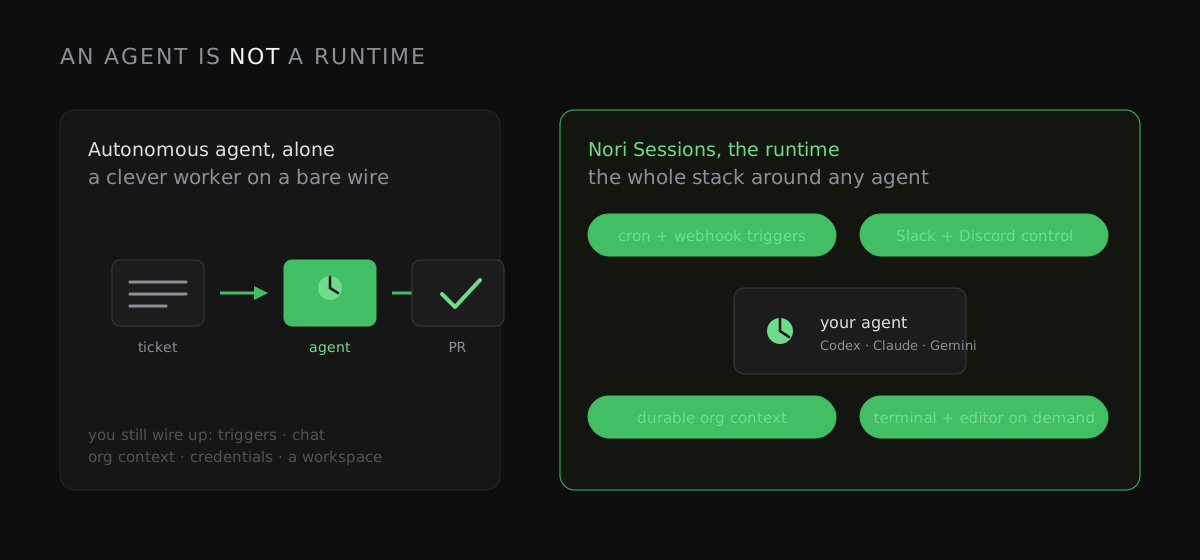
An agent is not a runtime
“Takes a task and returns a PR” is now a commodity. Before an agent ships a PR from a cloud machine, something has to stand up the machine, load the agent, connect GitHub and chat, route the model, load your org’s instructions, and give a human a way in when the agent gets stuck. Most products here pair their own agent with their own runtime and their own token billing. That is a fine trade when the vendor’s agent is the one you want. It is a worse trade when your team wants different agents for different jobs, or already pays for model subscriptions.
Where Nori Sessions fits, and where it doesn’t
Nori Sessions is a runtime, not a competing agent. Each session is a cloud machine that runs the harness you choose, with the surrounding stack already set up:
- Any harness. Claude Code, Codex, Gemini CLI, Cursor, OpenCode, Droid, Amp, Goose, or any ACP agent.
- We never charge for tokens. Bring your own Claude or ChatGPT subscription, API keys, or LLM gateway. No markup, no provider lock-in, and no incentive for us to make your agents burn more tokens.
- Slack, Discord, web, and CLI, plus cron and webhook automations.
- Opinionated defaults. Workflow skills, org skillsets, and memories load into every session.
- Enterprise. Bring your own compute, IdP (SAML, SCIM, OIDC), LLM gateway, token provider, and memory provider, in your cloud or on-prem.
Pricing as of October 2026: a free 30-day trial (5 runtimes, no card), Developer $99/mo, Team $250/mo, and Enterprise custom. Teams have merged more than 100,000 PRs with Nori.
Where something else is the better choice: if you want one fully managed agent and do not care which model it uses, Devin or Codex is less to set up. If you need a documented air-gapped deployment with on-prem models today, Factory has it. If you want free, open-source, and self-hosted, OpenHands is the pick. If you are one developer on GitHub, Jules or the Codex in your ChatGPT plan will cost less than $99 a month.
Subscribe to the newsletter
Weekly updates and long-form essays from the Nori team on AI agents and the agent ecosystem.
The bottom line
Already paying for ChatGPT? Start with Codex. Want the most complete single-vendor agent with enterprise controls? Devin. Need air-gapped or EU deployment? Factory. Want open source? OpenHands. Solo on GitHub and Gemini? Jules. On Cursor? Its cloud agents. If your team wants to run several of these agents side by side on subscriptions you already pay for, from Slack or Discord, on a schedule, with your org’s context loaded, that is what Nori Sessions is built for.
Start a free Nori Sessions trial or read the full cloud coding agents comparison.
Frequently asked questions
What is an autonomous AI software engineer?
An autonomous AI software engineer is a coding agent that takes a task, such as a ticket, an issue, or a plain-English prompt, and works it end to end on a cloud machine: it clones the repository, plans the change, writes and tests the code, and opens a pull request for review without a human driving each step. Devin, OpenAI Codex, Google Jules, Cursor cloud agents, Factory, and OpenHands are all versions of this idea.
Which autonomous AI software engineer is best in 2026?
There is no single winner as of October 2026. OpenAI Codex is the easiest start if you already pay for ChatGPT. Devin is the most complete single-vendor agent. Factory fits enterprises that need EU or air-gapped deployment. Google Jules is the simplest GitHub-plus-Gemini option. OpenHands is the open-source pick. Cursor cloud agents suit Cursor teams. Nori Sessions fits teams that want to run several harnesses on their own model subscriptions without paying for tokens.
How much do autonomous AI coding agents cost as of October 2026?
Most combine a plan with metered usage. Devin has Free, Pro at $20/month, Max at $200/month, and Teams from $80/month, then prepaid credits. OpenAI Codex is included in ChatGPT plans from Free through Plus at $20/month and Pro from $100/month, with credits for extra usage. Factory runs from Pro at $20/month to Max at $200/month, with Teams at $60/month plus $40 per seat. Google Jules has a free tier of 15 tasks a day, with more on Google AI Pro and Ultra. OpenHands is free to self-host as open source, with Teams at $499/month for 10 seats. Cursor cloud agents need a paid Cursor plan and bill at API pricing. Nori Sessions is Developer $99/month or Team $250/month and never charges for tokens.
Can I run these agents on a schedule or from Slack?
Mostly yes. Devin automations run on cron or one-time schedules, webhooks, and Slack, GitHub, Linear, Jira, and PagerDuty events. OpenAI Codex runs scheduled tasks and has a Slack integration. Factory automations start Droid sessions, with webhook triggers in Private Preview. Cursor cloud agents start from Slack, Linear, GitHub, or the API. OpenHands responds to Slack mentions. Google Jules starts from a GitHub issue label. Nori Sessions supports cron and webhook automations and is driven from Slack, Discord, the web, and the CLI.
Can I use my own Claude or ChatGPT subscription?
It varies. Codex runs on your ChatGPT plan. Devin lets a ChatGPT Go, Plus, or Pro plan pay for GPT usage but does not support Claude subscriptions or third-party API keys. Factory supports bring-your-own-key in its CLI and desktop app but documents no subscription support. Cursor bills third-party models at API list price. OpenHands uses your own LLM key. Nori Sessions accepts your Claude or ChatGPT subscription, API keys, or an LLM gateway, and never charges for tokens.
What is the difference between an autonomous agent and an agent runtime?
An autonomous agent is the worker that reads a task and proposes code. An agent runtime is the machine, triggers, chat integrations, credentials, and org context it runs inside. Most autonomous engineering products bundle one agent with their own runtime. A runtime like Nori Sessions runs whichever harness you choose, such as Claude Code, Codex, or Gemini CLI, and supplies the triggers, chat control, and context around it.
Are there open-source autonomous AI software engineers?
Yes. OpenHands by All Hands is MIT-licensed, can be self-hosted, and has a hosted cloud and enterprise product. Broccoli is an MIT-licensed project that turns Linear tickets into pull requests with Claude and Codex on your own Google Cloud project. Open-source agents give you data control and model choice, but you operate the infrastructure around them.
Sources
- Devin self-serve billing — Cognition
- Devin ChatGPT billing — Cognition
- Devin deployment overview — Cognition
- Devin Outposts — Cognition
- Devin SCIM and SSO — Cognition
- Devin automations — Cognition
- Devin integrations — Cognition
- Codex cloud — OpenAI
- Codex pricing — OpenAI
- Codex automations — OpenAI Academy
- Factory pricing — Factory
- Factory automations — Factory
- Factory network and deployment — Factory
- Factory OpenCompute — Factory
- Factory BYOK — Factory
- Factory raises $200M at $5B valuation — HPCwire (secondary)
- Jules — Google
- Jules usage limits — Google
- Google AI plans — Google
- OpenHands pricing — All Hands
- OpenHands Slack integration — All Hands
- Cursor cloud agents — Cursor
- Cursor self-hosted machines — Cursor
- Cursor pricing — Cursor
- SpaceX completes Cursor acquisition — The Next Web (secondary)
- Claude Tag overview — Anthropic
- Amp pricing — Amp
- Open infrastructure for building a software factory — Warp
- Replicas — background coding agents
- Broccoli — open-source ticket-to-PR agent