What is the best Slack-driven coding agent in 2026?
It depends on what you already pay for. On Claude Team or Enterprise, Claude Tag is the most complete @Claude teammate for Slack channels. GitHub Copilot customers can try Copilot’s Slack coding agent (public preview), and ChatGPT workspaces can hand Slack threads to Codex Cloud through @ChatGPT. Devin and Cursor fit teams already standardized on those agents. Roomote is the cheapest self-hostable option for small teams. Choose Nori Sessions to run any agent harness from Slack or Discord, with cron and webhook automations, on your own subscriptions and no token charges.
What is a chat-native coding agent?
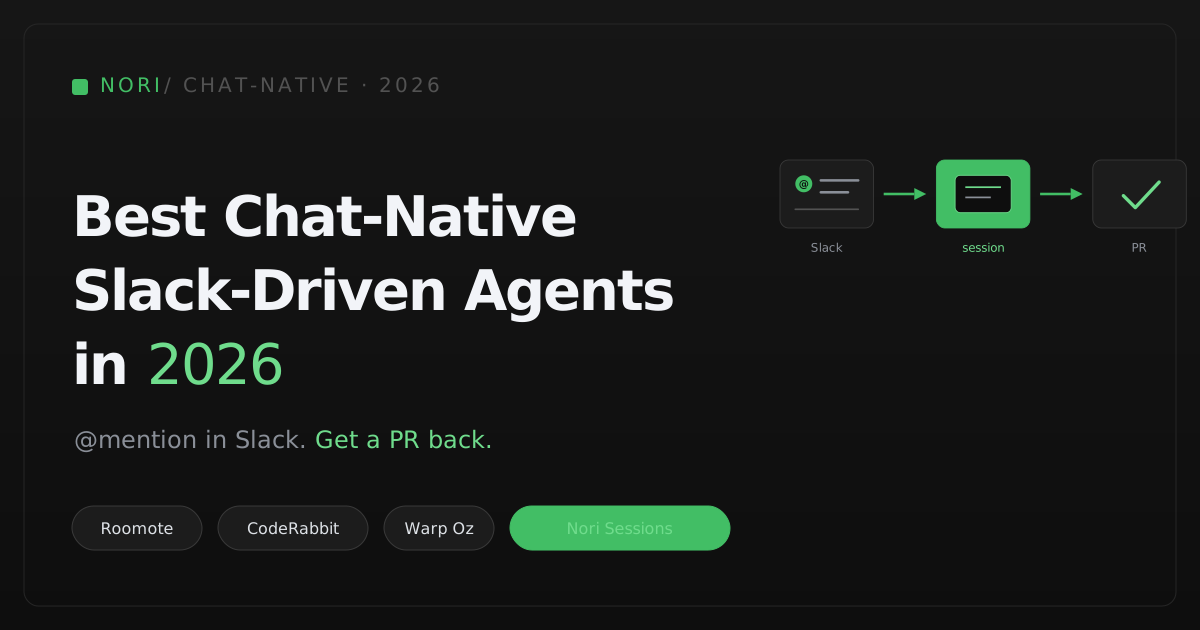
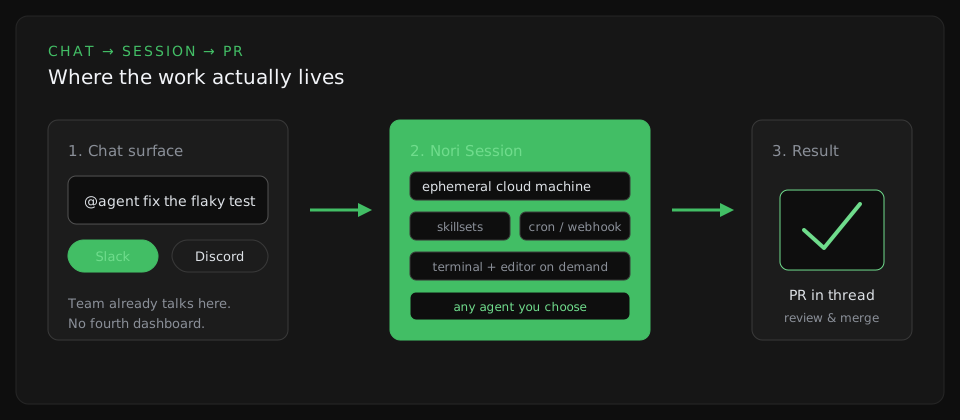
A chat-native coding agent is a coding agent you start and steer from a team chat tool — usually Slack, sometimes Microsoft Teams or Discord — instead of an IDE or a separate dashboard. You mention the agent in a channel or thread; it reads the thread for context, works in a cloud machine or sandbox (clone, edit, run tests), posts progress back to the thread, and usually finishes with a pull request for human review. It is for engineering teams whose bug reports, alerts, and decisions already happen in chat. The main differences between products are which agent and models run behind the mention, what can start work when nobody is typing (schedules, webhooks), what context carries over between runs, where the machine runs, and how usage is billed.
The chat-native field as of October 2026
Claude Tag (Anthropic) “puts Claude in your Slack channels with admin-governed access.” Anyone in a paired channel can tag @Claude; it works in an ephemeral sandbox and returns code changes as draft pull requests through the Claude GitHub App. It is in public beta on Claude Team and Enterprise plans, on Anthropic’s own service only. Channel work draws on an organization usage balance with an Owner-set spend limit; one-to-one DMs bill to the member’s own seat. Routines can run on a schedule, a channel watch, or a repository event. It runs Claude only, works in Slack only, and is not available with ZDR, CMEK, or HIPAA configurations (Claude Tag overview; security and data). Compare: Nori vs Claude Tag.
Codex in Slack (OpenAI). OpenAI’s current docs route Slack coding work through @ChatGPT: mention it in an enabled channel and it can start a separate Codex Cloud task and post the result back to the thread. A workspace admin must enable the ChatGPT app in Slack, cloud delegation must be available, and the task needs a published, workspace-shared environment; personal Cloud environments are not included (ChatGPT in Slack; Slack coding tasks). The natural pick if your company already runs on ChatGPT and Codex.
GitHub Copilot coding agent in Slack is in public preview. You DM the GitHub app or mention it in a thread; Copilot works asynchronously in a cloud sandbox and posts a summary with links to the pull requests or issues it created. It needs a paid Copilot plan, the GitHub app for Slack, and cloud sandboxes enabled; only users with write access to a repository can trigger changes (GitHub Docs). The lowest-friction choice for teams that already live in GitHub and Copilot.
Devin (Cognition) connects to Slack and Microsoft Teams as well as GitHub, GitLab, Bitbucket, Azure DevOps, Jira, and Linear. Its automations start from Slack, GitHub, GitLab, Linear, Jira, PagerDuty, schedules, and webhooks. Plans are Free, Pro $20/mo, Max $200/mo, and Teams from $80/mo, with token quotas and then prepaid on-demand credits. It runs only Devin, and the agent “brain” always runs in Cognition’s cloud, though Outposts can run session machines on infrastructure you control (integrations; automations; billing). Compare: Nori vs Devin.
Cursor cloud agents can be started with @cursor in Slack or Linear, from GitHub, or through the API. They run in isolated VMs, need a paid plan, and are billed at API pricing; self-hosted machines can run tool execution on your workers while the agent loop and inference stay with Cursor. Cursor is now owned by SpaceX; the acquisition reportedly closed on 2026-08-14 (Cursor cloud agents; Cursor pricing; The Next Web). Compare: Nori vs Cursor cloud agents.
Warp runs Oz cloud agents from Slack: tag @Warp in a channel or thread, or DM the bot. The agent shares a link to a live remote session you can steer, then opens a pull request with your GitHub permissions and posts it to the thread (Warp Slack integration). Warp Factories, in closed beta, adds version-controlled pipelines with any model and harness per stage (Warp Agent, Claude Code, Codex), Slack/Teams, Linear/Jira, and GitHub/GitLab triggers, and bring-your-own inference and hosting. Terminal plans are Build $20/mo, Max $200/mo, and Business $45/user/mo billed annually (up to 25 seats); Factories pay-as-you-go bills at API rates plus 20% (Warp pricing; Warp Factories). Compare: Nori vs Warp Factories.
CodeRabbit Agent for Slack extends CodeRabbit’s review engine into planning and shipping from threads: it pulls context from tools like Linear or Figma, keeps a knowledge base with team, channel, and thread memory, runs scheduled tasks or tasks triggered by matching channel messages, and can open a pull request from the discussion (CodeRabbit Slack Agent docs). It is billed separately from review subscriptions at $0.40 per active agent minute, metered to the second, with free agent minutes for each new user (CodeRabbit Agent). A good fit if CodeRabbit already reviews your PRs.
Roomote, from the Roo Code team, has repositioned as “the cloud coding agent you actually own”: source-available (Fair Core License), built on the OpenCode harness with bring-your-own-key models, and usable from Slack, Microsoft Teams, Discord, and Telegram. Roomote Cloud costs $49/mo for up to 10 users, $249/mo for 11–50, and $499/mo for 51–100; self-hosting is free for up to 10 users (Roomote). The best value for a small team that wants to self-host.
Cosine is an AI software engineering agent you assign “in Jira, GitHub, or Slack the same way you would assign it to an engineer”; it works in the background and returns a pull request (What is Cosine?). Credits cover agent work, model calls, and cloud execution: Starter from $19/mo (4M credits), Team $199/mo (47M), Enterprise $999/mo (240M), with private deployment scoped with sales (Cosine pricing).
Amp Orbs give each thread a fresh cloud VM. You can @-mention Amp in Slack, point any HTTP webhook at an Orb, or let it schedule itself. Orbs are billed per minute with “no Amp token fees or limits,” and you can use your ChatGPT, Claude, or other subscriptions, or your own keys (Amp Orbs manual; Amp pricing). Compare: Nori vs Amp Orbs.
Grok Bot (xAI) is a beta of “always-on agents,” each with its own cloud computer, included with SuperGrok tiers and Cursor paid plans, running xAI models only, SaaS only (Introducing Grok Bot). Routines and Slack and Git triggers are reported by third parties (MindStudio). Compare: Nori vs Grok Bot.
OpenHands (All Hands) is an MIT-licensed coding agent with a hosted cloud and an enterprise product; you can @openhands in Slack, including on self-hosted deployments. Teams is $499/mo for 10 seats and Teams Plus $999/mo, with your own LLM key and Helm self-hosting on paid plans (OpenHands pricing; OpenHands Slack). Compare: Nori vs OpenHands.
Factory runs Droids from Slack, Linear, GitHub, Jira, and GitLab. Automations start a Droid session; webhook triggers are in private preview. Plans are Pro $20, Plus $100, and Max $200, Teams $60/mo plus $40/seat, and Business and Enterprise custom, with air-gapped enterprise deployments available (Factory Slack; Factory automations; Factory pricing). Compare: Nori vs Factory.
Nori Sessions is a runtime for the agents you already use, not a new agent. Run Claude Code, Codex, Gemini CLI, Cursor, OpenCode, Droid, Amp, Goose, or any ACP agent, and drive it from Slack, Discord, the web, or the CLI, with cron and webhook automations. Bring your own Claude or ChatGPT subscription, API keys, or LLM gateway; Nori never charges for tokens. Opinionated defaults (workflow skills, org skillsets, memories) load on every session. Plans: a free 30-day trial (5 runtimes, no card), Developer $99/mo, Team $250/mo, and Enterprise custom, which adds your own compute, IdP (SAML/SCIM/OIDC), LLM gateway, token provider, and memory provider, in your cloud or on-prem.
How they compare (as of October 2026)
| Product | Chat surfaces | Agent and models | Unattended triggers | Pricing (as of October 2026) | Your infrastructure |
|---|---|---|---|---|---|
| Claude Tag | Slack | Claude only | Schedule, channel watch, repo event | Team / Enterprise; org usage balance with spend limit | Self-hosted runners for sessions |
| Codex via @ChatGPT | Slack | Codex Cloud | — | ChatGPT workspace with cloud delegation | — |
| GitHub Copilot coding agent | Slack (public preview) | Copilot | — | Paid Copilot plan | — |
| Devin | Slack, Teams | Devin only | Schedules, webhooks, tool events | Free; Pro $20; Max $200; Teams from $80/mo; credits beyond quota | Outposts (machines); brain in Cognition’s cloud |
| Cursor cloud agents | Slack, Linear | Cursor agent | API | Paid plan; billed at API pricing | Self-hosted tool execution |
| Warp (Oz / Factories) | Slack, Teams | Warp Agent; Factories: any harness per stage | Linear/Jira, GitHub/GitLab | Build $20; Business $45/user (annual); Factories API rates (+20% PAYG) | Factories (closed beta): your inference and hosting |
| CodeRabbit Agent | Slack | CodeRabbit | Schedules, channel-message triggers | $0.40 per active agent minute | — |
| Roomote | Slack, Teams, Discord, Telegram | OpenCode harness, your keys | — | Cloud $49/mo (up to 10 users) to $499/mo (100) | Self-host, free up to 10 users |
| Cosine | Slack (plus Jira, GitHub) | Cosine | — | Credits; Starter from $19, Team $199, Enterprise $999 | Private deployment via sales |
| Amp Orbs | Slack | Amp harness; your subscriptions or keys | Webhooks, self-scheduling | Per-minute Orbs; no Amp token fees | — |
| Grok Bot | Slack (reported) | xAI models only | Routines (reported) | Beta; included with SuperGrok and Cursor paid plans | SaaS only |
| OpenHands | Slack | OpenHands, Claude, Codex; your key | — | Teams $499/mo (10 seats); Teams Plus $999/mo | Helm self-hosting on paid plans |
| Factory | Slack, Linear | Droid only | Automations; webhooks in private preview | Pro $20; Teams $60 + $40/seat | BYO compute in private preview; air-gapped Enterprise |
| Nori Sessions | Slack, Discord, web, CLI | Any harness; your subscriptions, keys, or gateway | Cron, webhooks | Developer $99/mo; Team $250/mo; no token charges | Enterprise: your compute, your cloud or on-prem |
Vendor-documented capabilities and pricing as of October 2026; “—” means not documented on the pages we cite. “Reported” marks third-party claims. See sources below and the cloud coding agents comparison hub.
How to choose a chat-native coding agent
- Which agent runs behind the mention. Claude Tag, Devin, Factory, Cosine, and Grok Bot each run their own agent or model family. Warp Factories, OpenHands, Roomote, Amp, and Nori Sessions let you bring more of your own models or harnesses.
- Which chat tools you use. Most products are Slack-first. Devin, Warp, and Roomote also cover Microsoft Teams; Roomote and Nori Sessions cover Discord.
- What starts work when nobody is typing. Schedules and webhooks are how overnight dependency bumps and alert-driven fixes start. Check whether triggers are generally available or still in preview.
- What it remembers. Channel memory (Claude Tag), knowledge bases (CodeRabbit), and org skillsets and memories (Nori Sessions) solve the same problem in different ways.
- Where it runs. If code must stay in your network, look at self-hosted options (OpenHands, Roomote, Claude Tag self-hosted runners, Devin Outposts, Nori Sessions Enterprise) and check which parts still run in the vendor’s cloud.
- How it bills. Per-minute meters, credits, usage balances, and flat plans each fit different workloads. Model the cost of a month of your real usage before you commit.
Where Nori Sessions fits, and where it does not
Nori Sessions is the right pick when you want chat-native control without picking one lab’s agent: any harness, Slack and Discord, cron and webhook automations, your own subscriptions or keys with no token charges, and an Enterprise path to your own compute, identity provider, and LLM gateway. More than 100,000 pull requests have been merged across teams using it.
It is not the best fit for everyone:
- If your org is all-in on Claude and wants zero setup per user, Claude Tag is tightly integrated with Claude’s plans and admin controls.
- If you live in GitHub and Copilot, or in ChatGPT and Codex, the vendor’s own Slack app is the shortest path.
- If you work in Microsoft Teams, Devin, Warp, and Roomote support it; Nori Sessions covers Slack and Discord.
- If you are a small team that wants to self-host for free, Roomote’s free self-hosted tier is hard to beat.
- If CodeRabbit already reviews your PRs, its Slack Agent reuses that context.
Subscribe to the newsletter
Weekly updates and long-form essays from the Nori team on AI agents and the agent ecosystem.
The bottom line
Start with what you already pay for: Claude Tag on Claude Team or Enterprise, Copilot’s Slack agent on GitHub Copilot, Codex via @ChatGPT on ChatGPT, Devin or Cursor if your team already runs them. Look at Roomote or OpenHands if self-hosting matters most. Choose Nori Sessions when you want one runtime for whichever agents your team prefers, driven from Slack or Discord and from automations, with flat plans and no token charges.
Start a free 30-day Nori Sessions trial (5 runtimes, no card).
Frequently asked questions
What is a chat-native coding agent?
A chat-native coding agent is a coding agent you start and steer from a team chat tool, usually Slack, instead of an IDE or dashboard. You mention it in a thread, it works in a cloud machine or sandbox, posts progress back to the thread, and usually returns a pull request for review. Claude Tag, Codex via @ChatGPT, GitHub Copilot, Devin, Cursor, Warp, CodeRabbit, Roomote, Cosine, Amp, OpenHands, Factory, and Nori Sessions all offer some version of this loop.
Which Slack-driven coding agent is best in 2026?
It depends on what you already use. As of October 2026, Claude Tag suits Claude Team and Enterprise customers, Copilot’s Slack agent (public preview) suits GitHub Copilot customers, and @ChatGPT can hand Slack threads to Codex Cloud. Devin and Cursor suit teams already on those agents. Roomote is the low-cost self-hosted option. Nori Sessions suits teams that want to run any agent harness from Slack or Discord with cron and webhook automations and no token charges.
How much do chat-native coding agents cost?
As of October 2026: Claude Tag bills channel work to an organization usage balance with a spend limit on Team and Enterprise plans. CodeRabbit Agent is $0.40 per active agent minute. Roomote Cloud is $49/month for up to 10 users and free to self-host for up to 10 users. Cosine starts at $19/month in credits. Devin Teams starts at $80/month. Warp Business is $45/user/month billed annually. OpenHands Teams is $499/month for 10 seats. Nori Sessions is Developer $99/month or Team $250/month, with no token charges.
Can chat-native agents also run on a schedule or webhook?
Many can, as of October 2026. Claude Tag runs routines on a schedule, a channel watch, or a repository event. Devin automations support schedules and webhooks. CodeRabbit Agent runs scheduled tasks and channel-message triggers. Amp Orbs accept webhooks and schedule themselves. Factory webhook triggers are in private preview. Nori Sessions supports cron and webhook automations alongside Slack and Discord.
What is the difference between a Slack bot and a chat-native agent runtime?
A Slack bot answers in the thread. A chat-native agent runtime starts a cloud machine, loads your team’s context, runs a coding agent that can clone, edit, and test code, and returns a reviewable pull request to the thread. Some runtimes run only their own agent; others, such as Nori Sessions, Warp Factories, and OpenHands, can run third-party agents.
Do I need Discord as well as Slack for agent control?
Most engineering teams only need Slack or Microsoft Teams. Discord matters for open-source projects and communities. As of October 2026, Roomote and Nori Sessions support Discord; Devin, Warp, and Roomote support Microsoft Teams.
Sources
- Work with Claude Tag — Claude docs
- How Claude Tag works — Claude docs
- Claude Tag security and data — Claude docs
- Use ChatGPT and Codex in Slack — OpenAI
- Slack coding tasks — OpenAI
- Integrate Copilot coding agent with Slack — GitHub Docs
- Devin integrations
- Devin automations
- Devin self-serve billing
- Devin deployment overview
- Cursor cloud agents
- Cursor self-hosted machines
- Cursor pricing
- SpaceX completes Cursor acquisition — The Next Web
- Warp Slack integration
- Warp Factories announcement
- Warp deployment patterns
- Warp pricing
- CodeRabbit Agent for Slack
- CodeRabbit Slack Agent documentation
- Roomote (pricing and deployment)
- What is Cosine? — Cosine docs
- Cosine pricing
- Amp Orbs manual
- Amp pricing
- Introducing Grok Bot — xAI
- Grok Bot overview — MindStudio (third party)
- OpenHands pricing
- OpenHands Slack integration
- Factory Slack integration
- Factory automations
- Factory pricing
- Factory organization pricing
- Factory enterprise deployment