What is the best environment provisioning platform for AI coding agents in 2026?
It depends on what you are building. If you are building your own agent product and need isolated compute behind an SDK, use a sandbox API: E2B, Modal, or Daytona for fast per-second sandboxes, or Runloop for team-shared Blueprints and VPC deployment. If you want spec-driven workflows in your IDE and CI, look at Zencoder. If your team wants to run existing agents such as Claude Code or Codex from Slack with shared org context and scheduled runs, Nori Sessions fits. For a single managed agent, compare Devin or Factory.
What agent environment provisioning is
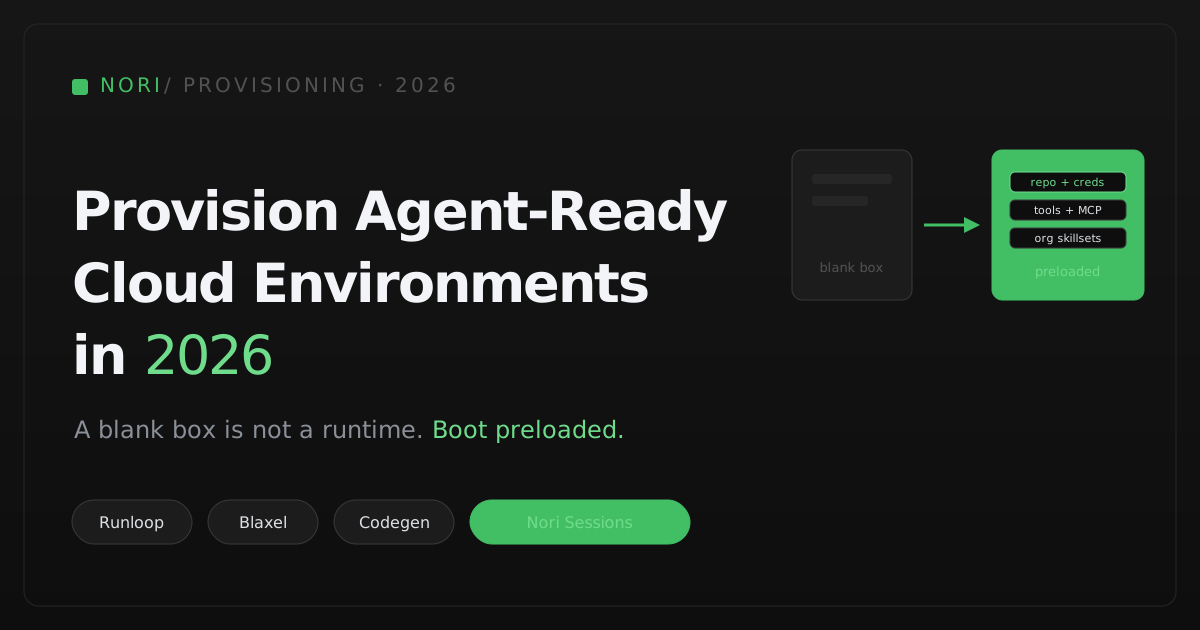
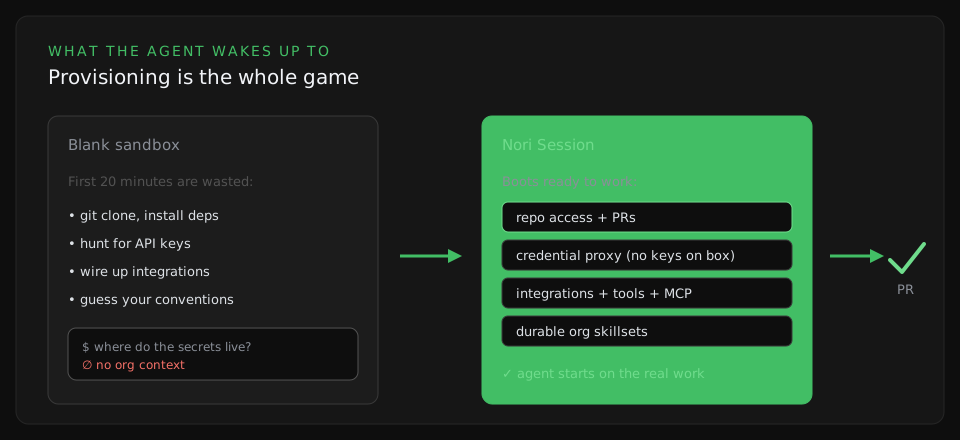
Environment provisioning for AI coding agents is the work of preparing an isolated machine so an agent can act on a real codebase: cloning the repository, supplying credentials, installing languages, tools, and MCP servers, and loading the team’s conventions. It is for engineering teams that run agents unattended or in parallel, and for companies building agent products that need a fresh, safe machine per task. A provisioning platform lets you define that environment once (as an image, template, snapshot, or setup script), reproduce it for every run, isolate it from your own systems, and tear it down afterward.
Products in this space sit at two layers. Sandbox APIs (E2B, Modal, Daytona, Runloop, Blaxel) give you an isolated machine and an SDK; you write the code that loads your repo and runs your agent. Agent platforms and runtimes (Zencoder, Nori Sessions, and managed agents like Devin and Factory) sit on top of a machine and decide which agent runs, how people start it, and what context it carries. Neither layer is better in general; they solve different problems.
The provisioning field, as of October 2026
Sandbox APIs: the right layer if you are building your own agent
E2B describes a sandbox as “a fast, secure Linux VM created on demand for your agent.” Templates define the starting environment, and pausing a sandbox saves both filesystem and memory until you kill it, with JavaScript/TypeScript and Python SDKs (E2B docs). As of October 2026, Hobby is free with $100 of one-time credits, 20 concurrent sandboxes, and one-hour sessions; Pro is $150/month plus usage with 24-hour sessions; Enterprise has a $3,000/month usage minimum and BYOC on request (E2B pricing). It is a strong default for teams building an agent product that need many short-lived, per-second-billed sandboxes.
Modal Sandboxes run on either gVisor or a VM runtime that gives each sandbox its own Linux kernel (so Docker works inside), last up to 24 hours, and can be continued from filesystem snapshots, with Python, JavaScript, and Go SDKs (Modal Sandboxes guide). As of October 2026, Starter is $0 plus compute with $30/month in credits and Team is $250/month plus compute with $100/month in credits (Modal pricing). A good fit if you already run Python workloads or GPUs on Modal.
Daytona positions itself as “secure and elastic infrastructure for running your AI-generated code,” claiming sub-90 ms sandbox creation, SDK-built snapshots, and save-and-resume of agent state (Daytona). As of October 2026 it bills per second (vCPU $0.0504/hour, memory $0.0162/GiB-hour) with $200 of free compute, and offers Enterprise SSO, audit logs, and bring-your-own-cloud through sales (Daytona pricing).
Runloop sells Devboxes: VM-isolated environments for agents, created on demand, with team-shared Blueprints (custom images) and snapshot, suspend, and resume for long-running tasks (Runloop docs). As of October 2026, Basic is free plus usage, Pro is $250/month plus usage, and Enterprise adds deployment into your own cloud account (VPC); Runloop states it is SOC 2 Type II certified (Runloop pricing). The pick for teams that want shared images and in-VPC deployment without running the infrastructure themselves.
Blaxel runs one microVM per agent or job that scales to zero and resumes from standby in about 25 milliseconds, alongside batch jobs and MCP server hosting; its session-based Agent Runtime is still marked “coming soon” (Blaxel). As of October 2026 it is pay-as-you-go at $0.0000115 per GB of RAM per second with up to $200 in credits, and HIPAA is a $250/month add-on (Blaxel pricing). Blaxel joined Baseten in September 2026; the platform keeps running and Baseten plans to build sandboxes on its technology (Blaxel announcement).
Other credible options: Freestyle (full Linux VMs for AI agents), Namespace (Devboxes for AI coding agents on Linux, macOS, and Windows), and the Kubernetes Agent Sandbox project for running isolated agent code on your own cluster.
Agent platforms and team runtimes: the right layer if you want to run agents, not build one
Zencoder now describes itself as “AI orchestration for code and work.” Its Zenflow product runs spec-driven workflows with parallel execution and cross-agent review in a desktop app, IDE, or CI/CD pipeline (Zencoder), triggered on a schedule, a webhook, a PR event, or a Jira update, with BYOK for OpenAI and Anthropic and cloud, on-prem, or hybrid deployment (Zenflow). As of October 2026, Pro is $45, Pro Plus $95, and Pro Max $195 per user per month billed monthly, with SSO and audit logs from Pro Plus (Zencoder pricing).
Nori Sessions is a team runtime: each session is a cloud machine that runs the coding agent you choose (Claude Code, Codex, Gemini CLI, Cursor, OpenCode, Droid, Amp, Goose, or any ACP agent) with your own Claude or ChatGPT subscription, API keys, or LLM gateway. Teams drive sessions from Slack, Discord, the web, or the CLI, and schedule them with cron and webhook automations. Every session loads opinionated defaults: workflow skills, org skillsets, and memories. Nori never charges for tokens, so there is no markup and no provider lock-in. Enterprise adds bring-your-own compute, IdP (SAML, SCIM, OIDC), LLM gateway, token provider, and memory provider, in your cloud or on-prem.
If you want a fully managed agent rather than a runtime, see our head-to-heads with Devin, Factory, Cursor cloud agents, Claude Tag, OpenHands, Amp Orbs, Warp Factories, and Grok Bot, or the cloud coding agents comparison hub.
What changed since July 2026
- Codegen was acquired by ClickUp in December 2025, and its standalone product was retired on January 16, 2026; codegen.com now points to ClickUp (ClickUp announcement). The July edition should not have listed it.
- Runtime (runtm.com) now positions itself as “the AI agent harness for payment teams” rather than a coding-agent environment, and its public pricing is a free Pilot for approved teams plus custom Enterprise (Runtime; Runtime pricing). We removed it from this guide.
- Blaxel joined Baseten (September 2026).
- We added E2B, Modal, and Daytona, which are the sandbox APIs most teams building their own agents evaluate first.
How they compare
| Platform | Layer | How the environment is defined | How runs start | Pricing (as of October 2026) |
|---|---|---|---|---|
| E2B | Sandbox API (Linux VMs) | Templates; pause keeps filesystem and memory | Your code (JS/TS, Python SDK) | Hobby $0 + $100 one-time credits; Pro $150/mo + usage |
| Modal | Sandbox API (gVisor or VM runtime) | Code-defined images; filesystem snapshots; up to 24h per sandbox | Your code (Python, JS, Go SDK) | Starter $0 + compute; Team $250/mo + compute |
| Daytona | Sandbox API | SDK-built snapshots; save and resume | Your code (SDK) | Pay-as-you-go, per second; $200 free compute |
| Runloop | Devbox API | Blueprints + snapshot, suspend, resume | Your code (API) | Basic usage-only; Pro $250/mo + usage |
| Blaxel (now part of Baseten) | Sandbox API (microVMs) | Images; ~25 ms resume from standby | Your code (SDK) | Pay-as-you-go, $0.0000115 per GB-second |
| Zencoder | Agent workflow platform | Spec-driven Zenflow workflows; runs in IDE, desktop app, or CI/CD | IDE, desktop app; schedule, webhook, PR, Jira triggers | $45–$195/user/mo (monthly billing) |
| Nori Sessions | Team agent runtime | Org skillsets, memories, workflow skills; any harness | Slack, Discord, web, CLI; cron and webhook automations | Free 30-day trial; $99/mo Developer; $250/mo Team; Enterprise custom |
Vendor-documented capabilities and list pricing as of October 2026. See sources below.
How to choose an agent environment platform
- Are you building an agent, or running one? If agents are your product, you want a sandbox API you control end to end: E2B, Modal, Daytona, Runloop, or Blaxel. If your engineers want to hand tasks to existing agents, a runtime or agent platform saves you building the orchestration, chat, and scheduling layers.
- How much do you assemble by hand? An SDK and an image are power tools. Count the setup code, secrets handling, and triggers you will write and maintain yourself.
- Does the environment carry your org’s context? An image pins your tools. Conventions, review norms, and the right test command need a separate mechanism, whether you build it or the platform provides it.
- Are you locked to one agent or model? Sandbox APIs are agent-agnostic by design. Platforms differ: check which harnesses run and whether you can bring your own keys or subscriptions.
- What starts a run when nobody is watching? Cron, webhooks, PR events, and ticket updates are how overnight and alert-driven work happens without a human.
- Can you forecast the bill? Per-second billing is efficient for bursty, short tasks; flat plans are easier to budget for long-running team sessions. Pick the model that matches your workload.
Where Nori Sessions fits, and where it does not
Nori Sessions is a good fit when a team wants to run existing coding agents (Claude Code, Codex, Gemini CLI, Cursor, OpenCode, Droid, Amp, Goose, or any ACP agent) against its repos from Slack, Discord, the web, or the CLI, with org skillsets and memories loaded into every session, cron and webhook automations, and its own Claude or ChatGPT subscription, API keys, or LLM gateway. Nori never charges for tokens. Plans, as of October 2026: a free 30-day trial (5 runtimes, no card), Developer at $99/month, Team at $250/month, and Enterprise custom. Teams have merged more than 100,000 PRs with Nori.
Pick something else when you are building your own agent product and need thousands of short-lived, per-second-billed sandboxes behind an SDK: E2B, Modal, Daytona, Runloop, or Blaxel is the better layer, and a team runtime would be overhead. If you want spec-driven workflows inside your IDE and CI, Zencoder is built for that. If you want one vendor to supply the agent, model, and workflow, a managed agent like Devin or Factory may suit you better.
Subscribe to the newsletter
Weekly updates and long-form essays from the Nori team on AI agents and the agent ecosystem.
The bottom line
As of October 2026, the provisioning market has consolidated: Codegen is gone, Runtime has pivoted to payments, and Blaxel is now part of Baseten. For builders of their own agents, E2B, Modal, and Daytona are the sandbox APIs to evaluate first, with Runloop the stronger choice for shared Blueprints and in-VPC deployment. For teams that want to run existing agents with shared org context, chat control, and scheduled runs on a flat plan without token charges, Nori Sessions is built for that job.
Start a free 30-day Nori Sessions trial and see whether a team runtime fits how you work.
Frequently asked questions
What is environment provisioning for AI coding agents?
Environment provisioning is everything that has to be true before an AI coding agent can do useful work: an isolated machine with the repository cloned, credentials available, the right tools and MCP servers installed, and the team’s conventions loaded. Provisioning is how that environment gets defined once (an image, template, snapshot, or setup script), reproduced for every run, and torn down afterward. It is the difference between an agent that starts on the task in seconds and one that spends its first minutes on setup.
What is the difference between an agent sandbox and an agent runtime?
A sandbox is an isolated machine with an API: E2B, Modal Sandboxes, Daytona, Runloop, and Blaxel sell this, billed mostly by compute time. You write the code that starts it, loads your repo and secrets, and runs your agent. A runtime adds the layers above the box for a team: which agent runs, how humans start and steer it (Slack, web, CLI), scheduled and event-driven runs, and shared org context. If you are building your own agent product, a sandbox is usually the right layer. If your team wants to run existing coding agents, a runtime saves the assembly work.
How do teams provision environments for AI coding agents?
As of October 2026: E2B uses templates and can pause a sandbox with its filesystem and memory intact. Modal Sandboxes are defined in Python, JavaScript, or Go and can be restored from filesystem snapshots. Daytona builds snapshots through its SDK. Runloop uses Blueprints (team-shared images) plus snapshot, suspend, and resume. Blaxel resumes microVMs from standby in about 25 milliseconds. Zencoder’s Zenflow runs spec-driven workflows from your IDE, desktop app, or CI/CD. Nori Sessions provisions each session from org skillsets, memories, and connected integrations, and runs whichever coding agent you choose.
How much does agent environment provisioning cost in 2026?
As of October 2026, sandbox APIs bill by usage: E2B Hobby is free with $100 of one-time credits and Pro is $150 a month plus usage; Modal Starter is $0 plus compute with $30 of monthly credits and Team is $250 a month plus compute; Daytona is pay-as-you-go with $200 of free compute; Runloop Basic is usage-only and Pro is $250 a month plus usage; Blaxel is pay-as-you-go at $0.0000115 per GB of RAM per second. Zencoder is $45 to $195 per user per month billed monthly. Nori Sessions is a free 30-day trial, then Developer at $99 a month or Team at $250 a month, with Enterprise custom; Nori never charges for tokens.
Can I run any coding agent, or am I locked to one vendor?
It depends on the layer. Sandbox APIs like E2B, Modal, Daytona, Runloop, and Blaxel are agent-agnostic: you run whatever code you put in the box. Zencoder runs its own workflows and lets you bring your own OpenAI or Anthropic keys. Managed agents like Devin and Factory run their own agent. Nori Sessions runs Claude Code, Codex, Gemini CLI, Cursor, OpenCode, Droid, Amp, Goose, or any ACP agent, with your own Claude or ChatGPT subscription, API keys, or LLM gateway.
Why does preloaded org context matter for coding agents?
An agent that does not know your conventions rediscovers them on every run: the wrong test command, the wrong directory layout, the wrong review norms. A reproducible image pins your tools, but not how your team works. Org context loaded into every session, such as workflow skills, shared instructions, and memories, is what lets the twentieth run benefit from the first nineteen. You can build this yourself on any sandbox; Nori Sessions ships it as org skillsets and memories.
Sources
All vendor pages were read on October 19, 2026.
- E2B documentation (sandboxes, templates, pause and resume)
- E2B pricing
- Modal Sandboxes guide
- Modal pricing
- Daytona
- Daytona pricing
- Runloop Devboxes overview (Blueprints, snapshots)
- Runloop pricing (plans, VPC deployment, SOC 2 Type II)
- Blaxel (products, compliance, resume time)
- Blaxel pricing
- Blaxel is joining Baseten
- Baseten: Blaxel is joining Baseten
- Zencoder
- Zencoder Zenflow (triggers, BYOK, deployment)
- Zencoder pricing
- ClickUp acquires Codegen
- ClickUp acquires Codegen — Business Wire
- Runtime (runtm.com)
- Runtime pricing
- Freestyle
- Namespace
- Agent Sandbox for Kubernetes