What is the best multi-agent orchestration platform in 2026?
It depends on where you want the agents to run. To run a handful of agents on your own Mac, Conductor is the simplest cockpit, Superset is the most agent-agnostic and adds remote hosts and automations, and Sculptor suits you if you want container isolation and MIT-licensed code. For an enterprise fleet wired into GitHub, Jira, and Microsoft Teams, Augment Cosmos is strong; for batch modernization of very large codebases, Blitzy. Nori Sessions fits teams that want any harness running in parallel cloud sessions, driven from Slack, Discord, or cron, on flat plans that never charge for tokens.
What is a multi-agent orchestration platform?
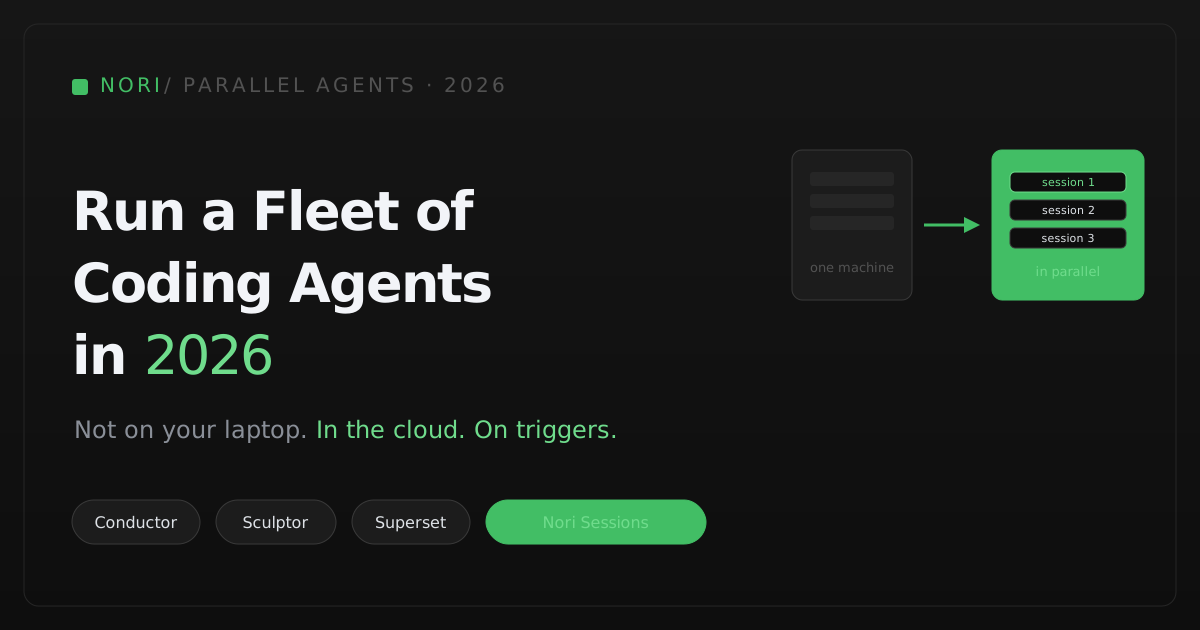
A multi-agent orchestration (or parallel-agent) platform lets one developer or team run many coding agents at the same time and manage them from one place. It gives each agent an isolated workspace — a git worktree, a container, or a cloud VM — so parallel agents do not overwrite each other, then collects their diffs and pull requests for human review. It is for engineers who already trust an agent such as Claude Code or Codex with a single task and now want to run several tasks at once. The products differ in where agents run (your machine or the cloud), which agents they support, and whether work can start without a human present.
The field still splits roughly in two. Local cockpits — Conductor, Sculptor, Superset — fan agents out across worktrees or containers on your own machine, and two of them now add cloud or remote options. Cloud fleets — Augment Cosmos, Blitzy, Nori Sessions, and the cloud agents covered in our cloud coding agents comparison — run the agents off your laptop entirely.
The parallel-agent field as of October 2026
Conductor describes itself as a way to “run parallel coding agents on your Mac”: it creates Claude Code, Codex, and Cursor agents in isolated workspaces (Conductor), and each workspace is its own git worktree with its own branch (Conductor docs). Since July it has added Conductor Cloud, where workspaces run in Vercel sandboxes so “even if you close the Conductor app, work continues.” As of October 2026 the plans are Free, Pro, Teams ($60/user/mo), and Enterprise custom; cloud workspaces need Pro or above (Conductor pricing). Its site does not document Slack control or scheduled runs. It is the easiest way to run a few agents at your desk.
Sculptor, from the research lab Imbue, hardens the isolation: every agent runs in its own container, so agents can execute code in parallel without touching your local environment (Sculptor). As of October 2026 it is MIT-licensed, describes itself as “an experimental research preview,” ships for Apple Silicon Macs and Linux, and has integrated support for Claude Code and the Pi harness while able to run any terminal-based agent (Sculptor on GitHub). It is a hands-on, single-machine tool with no documented scheduling or chat control.
Superset bills itself as “one workspace for Claude Code, Codex, and any coding agent” and advertises scaling to 100+ agents, each in its own git worktree (Superset). It has moved well beyond a local cockpit since July: you can add any machine as a host so workspaces keep running when your laptop sleeps, and Automations run agents on a schedule or when an event arrives and open PRs for review. Its code is source-available under the Elastic License 2.0, which Superset itself notes is not OSI-approved open source; the repository shows about 15,400 GitHub stars as of October 2026. Pricing: Free (one user, local workspaces), Pro $20/user/mo ($15 billed yearly) with remote access, automations, and Linear and Slack integrations, and Enterprise custom (Superset pricing). If you have your own machines to host agents, it is the cheapest route to an always-on fleet on this list.
Augment Code now leads with Cosmos, which it presents as a programmable software factory: agents “wake on events, do the work, and pull you in only at the checkpoints.” A PR, an alert, a cron schedule, or a webhook can start work; integrations include GitHub, GitLab, Jira, Linear, Slack, and Microsoft Teams; each session runs in a fresh VM, and a self-hosted daemon can connect your own machines (Augment Cosmos). Slack triggers fire on mentions or channel messages (Augment Slack docs). As of October 2026, Standard is $20/mo and Business $100/mo, each including that amount of usage; LLM usage is billed at the provider’s API list price plus a 40% service fee, and Enterprise is custom (Augment pricing). It is the most complete event-driven cloud fleet here, but you run Augment’s agent and pay a margin on tokens.
Blitzy plays a different game: enterprise long-horizon automation. It reverse-engineers a codebase into a knowledge graph, then coordinates “thousands of agents in parallel” for days or weeks, with more than 100,000 model calls in a single run, on codebases from one million to over 100 million lines. It raised $200M at a $1.4B valuation in May 2026 and reported a 66.5% SWE-Bench Pro score (SiliconANGLE; Business Wire). We could not verify a public price list or any chat or trigger surface on Blitzy’s own site as of October 2026; treat it as an enterprise, sales-led platform for large modernization projects.
Nori Sessions runs each agent in its own cloud session, so parallel work keeps going with your laptop closed. It is a runtime rather than an agent: Claude Code, Codex, Gemini CLI, Cursor, OpenCode, Droid, Amp, Goose, or any ACP agent, using your own Claude or ChatGPT subscription, API keys, or LLM gateway. You drive it from Slack, Discord, the web, or the CLI, and cron and webhook automations start sessions with no one attached. Pricing as of October 2026: a free 30-day trial (5 runtimes, no card), Developer $99/mo, Team $250/mo, Enterprise custom — and Nori never charges for tokens.
Several cloud coding agents also run tasks in parallel, usually with their own harness. As of October 2026: Devin runs only Devin, with schedule and webhook automations (Nori vs Devin); Factory’s automations start Droid sessions (Nori vs Factory); Cursor cloud agents run in isolated VMs and Cursor is now owned by SpaceX, a deal reported closed on August 14, 2026 (Nori vs Cursor cloud agents); Amp Orbs give each thread a fresh cloud VM billed per minute with no Amp token fees (Nori vs Amp Orbs); Warp Factories, in closed beta, lets each pipeline stage use any model and harness (Nori vs Warp Factories); and OpenHands is MIT-licensed with self-hosting on paid plans (Nori vs OpenHands).
Smaller local tools fill out the field: Baton and the MIT-licensed Parallel Code run several CLI agents, each in its own git worktree, and cmux is a free, open-source macOS terminal for running agents side by side.
How they compare
| Platform | Where agents run | Agents | Chat control |
Unattended triggers (cron / webhook) |
Pricing (as of October 2026) |
|---|---|---|---|---|---|
| Conductor | Your Mac; paid cloud workspaces (Vercel sandboxes) | Claude Code, Codex, Cursor | ✗ not documented | ✗ not documented | Free; paid Pro; Teams $60/user/mo |
| Sculptor | Your machine (Apple Silicon Mac, Linux), in containers | Claude Code, Pi, any terminal agent | ✗ | ✗ | MIT-licensed research preview |
| Superset | Your Mac or any host you add | Any CLI agent | Slack, Linear (Pro) | ✓ schedule + events (Pro) | Free; Pro $20/user/mo |
| Augment Cosmos | Their cloud (fresh VMs) or your machines via daemon | Augment’s agent, multiple models | ✓ Slack + Teams | ✓ cron + webhook + events | $20 or $100/mo incl. usage; LLM at list +40% |
| Blitzy | Blitzy’s platform | Blitzy’s orchestration | ✗ not documented | ✗ not documented | Enterprise, sales-led |
| Nori Sessions | Cloud sessions; Enterprise on your compute | Any harness or ACP agent | ✓ Slack + Discord | ✓ cron + webhook | Developer $99/mo; Team $250/mo; no token charges |
Vendor-documented capabilities and pricing as of October 2026. “Not documented” means we found no such feature on the vendor’s own pages. See sources below.
How to choose a parallel-agent platform
Six questions separate a tool you babysit from a fleet that runs itself:
- Where do the agents run? A cockpit on your Mac is only as available as your laptop. Cloud workspaces (Conductor Cloud, Augment, Nori) or your own always-on hosts (Superset) keep work going with the lid closed.
- Can it run without you watching? Interactive parallelism is a productivity boost. Cron, webhook, and event triggers are a different category — overnight dependency bumps and alert-driven fixes that launch themselves.
- How do you control it? A desktop window ties you to one seat. Starting and steering agents from Slack, Discord, or Teams lets the whole team drive the fleet.
- Are you locked to one agent? Platforms that run their own agent choose the harness for you. Agent-agnostic tools let you swap Codex for Claude Code without re-tooling.
- Does the fleet know your org? Ten agents that each rediscover your test command and review norms waste ten times the setup. Durable, preloaded context makes a fleet act like it works here.
- Can you forecast the bill? Check whether the vendor marks up tokens, bills per minute, or charges a flat plan, and whether you can use the model subscriptions you already pay for.
Where Nori Sessions fits, and where it doesn’t
Nori Sessions is a good fit when you want cloud parallelism without picking one vendor’s agent:
- We never charge for tokens. No markup and no usage metering, so our incentives match yours and you are not locked to a model provider. Bring your own Claude or ChatGPT subscription, API keys, or LLM gateway.
- Any harness. Claude Code, Codex, Gemini CLI, Cursor, OpenCode, Droid, Amp, Goose, or any ACP agent, in the same runtime.
- Slack, Discord, web, and CLI, plus cron and webhook automations that start sessions with no human attached.
- Opinionated defaults. Workflow skills, org skillsets, and memories load onto every session, so the tenth agent starts with your conventions.
- Enterprise on your terms. Bring your own compute, IdP (SAML, SCIM, OIDC), LLM gateway, token provider, and memory provider, in your cloud or on-prem.
Teams have merged 100,000+ PRs with Nori. It is not the best pick for everyone. If you only want to watch a few agents on your own Mac, Conductor, Sculptor, Superset, or Parallel Code cost less or nothing. If you already run always-on machines, Superset Pro adds remote hosts and automations for $20 per user. If your team lives in Microsoft Teams and wants triggers across GitHub, Jira, and alerts out of the box, Augment Cosmos covers more of that today. And for a multi-month rewrite of a 100-million-line codebase, Blitzy is built for exactly that.
Subscribe to the newsletter
Weekly updates and long-form essays from the Nori team on AI agents and the agent ecosystem.
The bottom line
Parallel agents are now table stakes, and the line between local and cloud has blurred since July: Conductor added cloud workspaces and Superset added remote hosts and automations. Pick a local cockpit if you want to supervise agents at your desk, Augment Cosmos for an event-driven enterprise factory with its own agent, Blitzy for very large batch modernization, and Nori Sessions if you want any harness running in cloud sessions, driven from chat and cron, on a flat plan with no token charges. For cloud agents head to head, see our cloud coding agents comparison.
Start a free 30-day Nori Sessions trial — 5 runtimes, no card.
Frequently asked questions
What is a multi-agent orchestration or parallel-agent platform?
It is a tool that lets one developer or team run many coding agents at the same time and manage them from one place. Each agent gets an isolated workspace, such as a git worktree, a container, or a cloud VM, so agents do not overwrite each other, and you review their output as it lands. The platforms differ mainly in where the agents run, which agents they support, and whether work can start without a human present.
Can you really run multiple coding agents at once?
Yes, and isolation is what makes it safe. Conductor, Superset, and Parallel Code give each agent its own git worktree, so parallel agents work on separate branches. Sculptor gives each agent its own container. Conductor Cloud, Augment Cosmos, and Nori Sessions run agents in isolated cloud environments. The mechanism varies, but the goal is the same: many agents working concurrently, each in a box of its own.
Do parallel-agent tools run on my machine or in the cloud?
Both, and the line has blurred. As of October 2026, Sculptor runs on your machine; Conductor runs on your Mac and offers cloud workspaces on paid plans; Superset runs locally or on any host you add. Augment Cosmos, Blitzy, and Nori Sessions run agents off your laptop, so work continues with the lid closed.
Can I run different agents in parallel, or am I locked to one vendor?
It depends on the tool. Conductor runs Claude Code, Codex, and Cursor; Sculptor and Superset can run any terminal or CLI agent. Augment and Blitzy run their own agent and orchestration. Nori Sessions is a runtime rather than an agent: you can run Claude Code, Codex, Gemini CLI, Cursor, OpenCode, Droid, Amp, Goose, or any ACP agent, with your own subscription, API keys, or LLM gateway.
How much do parallel-agent platforms cost in 2026?
As of October 2026: Conductor is free locally, with paid Pro and Teams plans (Teams is $60 per user per month); Superset is free for one user, with Pro at $20 per user per month; Sculptor is MIT-licensed. Augment’s Standard and Business plans are $20 and $100 per month including that much usage, with LLM usage billed at API list price plus 40%. Blitzy is sales-led. Nori Sessions has a free 30-day trial, Developer at $99 per month, Team at $250 per month, and Enterprise custom, and never charges for tokens.
Do parallel-agent platforms run unattended on a schedule?
Some do. As of October 2026, Superset Pro automations run agents on a schedule or on events, Augment Cosmos starts agents from cron, webhooks, PRs, and alerts, and Nori Sessions has cron and webhook automations. Conductor and Sculptor do not document scheduled runs. Among cloud agents, Devin and Amp also support scheduled or webhook-triggered work.
Sources
- Conductor (read October 19, 2026)
- Conductor docs — git worktrees
- Conductor pricing and Conductor Cloud
- Sculptor (Imbue) — parallel containers
- Sculptor on GitHub (license, platforms, agents)
- Superset — agents, hosts, automations, license
- Superset pricing
- Augment Cosmos
- Augment Cosmos Slack triggers (docs)
- Augment pricing
- Blitzy $200M raise — SiliconANGLE
- Blitzy $200M raise — Business Wire
- Devin automations
- Factory automations
- Cursor cloud agents
- SpaceX completes Cursor acquisition — The Next Web
- Amp pricing (Orbs)
- Amp Orbs manual
- Warp Factories announcement
- OpenHands pricing
- Baton — parallel CLI agents
- cmux — macOS agent terminal
- Parallel Code