Should you self-host your AI coding agents or use a managed service in 2026?
Self-host only if a compliance rule says code and prompts cannot leave your network. Then Coder Agents (fully self-hosted, air-gap capable) or OpenHands Enterprise is the strongest pick. If you trust a vendor’s agent but need execution on your machines, Devin Outposts, Cursor self-hosted machines, or Claude Tag self-hosted environments split the difference. For sandbox infrastructure in your own cloud, use Northflank BYOC. Most other teams are better served by a managed service; Nori Sessions is hosted by default, with bring-your-own compute on Enterprise.
What self-hosted and managed agent infrastructure mean
Coding-agent infrastructure is the machinery around a coding agent: the sandbox it executes in, the control plane that schedules and routes work, the credentials it uses, and the storage for transcripts and context. Self-hosted means your team runs all of it, from the control plane to the sandboxes, on your own cloud account or hardware. Managed means a vendor runs it and you get a workspace. In between are two hybrids: bring-your-own-cloud (BYOC), where a vendor’s software runs inside your account, and vendor runners, where the vendor’s cloud keeps the agent loop and your machines run the commands. The choice is for platform, security, and engineering leads deciding where agent work is allowed to happen.
Fully self-hosted: your servers, your rules
Coder Agents became generally available on September 9, 2026. The whole stack runs on your infrastructure, including air-gapped networks, and the organization chooses its models (Coder Agents GA). Coder v2.37 deprecated the older Coder Tasks feature in favor of Coder Agents and added headless agents through the API (Coder v2.37). As of October 2026, Community is free for up to 5 active agents, Premium is billed annually per user, and AI Premium is custom with unlimited agents and API-triggered headless agents; Slack support is notifications only (Coder pricing, Coder Slack notifications). Choose Coder when the mandate is air-gapped and you already run platform infrastructure.
OpenHands, from All Hands, is an open-source (MIT) coding agent with hosted and self-hosted products. As of October 2026, Teams is $499 a month for up to 10 seats and includes self-hosting, Teams Plus is $999 a month for up to 20 seats with SAML SSO, and Enterprise is custom; Teams tiers allow 5,000 sessions a month, and you bring your own LLM key (OpenHands pricing). It can drive third-party agents such as Claude Code, Codex, and Gemini CLI over ACP, runs cron-scheduled automations, and supports @openhands in Slack on self-hosted Enterprise, though that needs a public Slack endpoint and is not supported air-gapped (OpenHands ACP, automations, Slack). See Nori vs OpenHands.
Open-source agents you run yourself changed a lot this year. Goose moved from Block to the Linux Foundation’s Agentic AI Foundation under Apache-2.0. Cline stays free and open source, with VPC deployments on Enterprise. OpenCode remains open source. Kilo Code was acquired by Anaconda in July 2026. Continue joined Cursor and shut down its product. The Roo Code repository was archived in May 2026, and its team now builds Roomote, a self-hosted agent for Slack, Teams, and Discord. Refact.ai is shutting down Refact Cloud and continuing as local-first open source.
Bring your own cloud
Northflank runs self-serve in your AWS, GCP, Azure, Oracle, or CoreWeave account or on-prem, with microVM isolation through Kata Containers, Firecracker, or gVisor chosen per workload; its pricing page says there is “no added cost for running in your VPC” (Northflank BYOC, Northflank pricing). It is general-purpose infrastructure: you bring the agent, the triggers, and the team workflow.
Qodo now presents Qodo 3.0 with an “Agentic Toolbox” CLI; the Qodo Command name is no longer on its site. As of October 2026 it offers a 14-day trial, a Pro Team plan at $30 with credit packs at $0.012 per credit, and an Enterprise plan that deploys single-tenant, on-prem, or air-gapped with your own keys (Qodo pricing). Pick Qodo when agents should live in your CI and review pipeline.
Vendor runners: their agent, your machines
Several managed agents now let execution run on your infrastructure while their cloud keeps the agent loop, inference, or orchestration:
- Devin Outposts run session machines on infrastructure you control on Pro, Max, and Teams; the agent “brain” stays in Cognition’s cloud (Devin Outposts). See Nori vs Devin.
- Cursor self-hosted machines run tool execution on your workers; the agent loop and inference stay with Cursor, and team pools need Enterprise (Cursor self-hosted). See Nori vs Cursor cloud agents.
- Claude Tag self-hosted environments run sessions on runners in your network, with admin-added connectors unavailable there and egress default-deny (Claude Tag security). See Nori vs Claude Tag.
- Factory OpenCompute, its bring-your-own-compute option, is in private preview with limited availability (Factory OpenCompute). See Nori vs Factory.
- Warp Factories offer bring-your-own inference and hosting, while orchestration and transcripts go through Warp’s backend (Warp deployment patterns). See Nori vs Warp Factories.
| Platform | Where agents run | Deployment model | Chat control | Unattended triggers | Pricing |
|---|---|---|---|---|---|
| Coder Agents | Your infrastructure, to air-gapped | Fully self-hosted | Slack notifications | API-triggered | Free to 5 agents; paid per user |
| OpenHands | Your cluster or their cloud | Open source; self-host on paid plans | ✓ Slack | ✓ cron automations | Teams $499/mo (10 seats) |
| Northflank | Your cloud (BYOC) | BYOC platform | ✗ | You build them | Usage-based |
| Qodo | Your CI or their cloud | SaaS; on-prem or air-gapped on Enterprise | ✗ none found | CI | Pro Team $30 + credits |
| Devin, Cursor, Claude Tag runners | Your machines; agent loop in vendor cloud | Hybrid | ✓ Slack | ✓ vendor automations | Vendor plan + usage |
| Nori Sessions | Nori cloud; Enterprise: your cloud or on-prem | Managed; bring your own compute on Enterprise | ✓ Slack + Discord | ✓ cron + webhook | Developer $99/mo; no token charges |
Publicly documented capabilities and list prices as of October 2026. See vendor sources below.
The tradeoff everyone is actually making
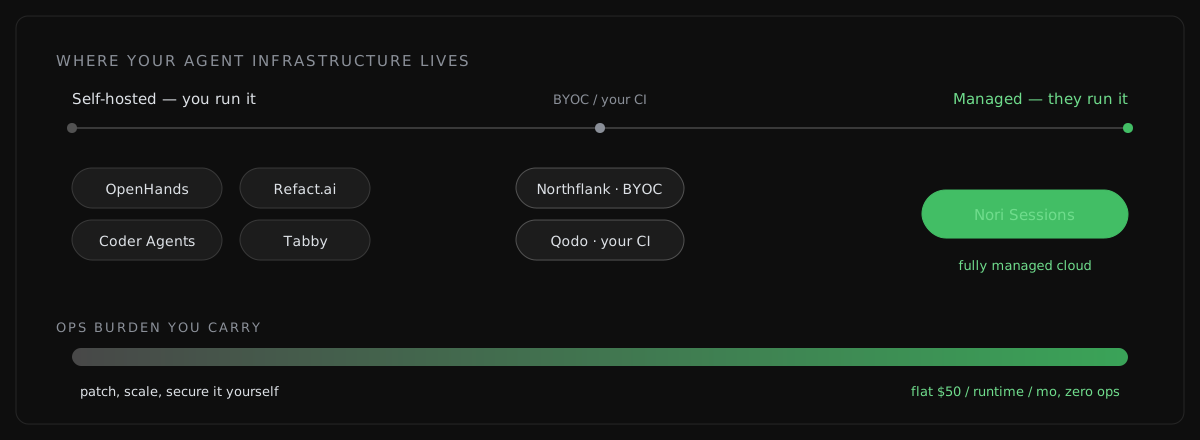
Self-hosting buys control and costs operations. Someone has to upgrade the control plane, patch the sandboxes, scale the cluster, and answer the page when a runner stalls. Hybrids reduce that work but leave the agent loop, inference, or transcripts in the vendor’s cloud, which matters if your rule is about prompts and model interactions rather than only source code. Ask your security team which data the rule actually covers: code, prompts, transcripts, credentials, or all four. The answer usually decides the category.
How to choose your agent infrastructure
- Do you have a real mandate? An air-gapped or data-residency requirement points to Coder Agents or self-hosted OpenHands. A preference to keep things in-house rarely survives the operations bill.
- Which data must stay inside? If only execution must, a vendor runner or BYOC may be enough. If prompts and transcripts must, you need a fully self-hosted stack or an Enterprise deployment in your cloud.
- Who patches the platform? Self-hosting puts upgrades, scaling, and security on your roadmap for good.
- How does work start? Check for schedules, webhooks, and chat. Coder documents API triggers; Northflank leaves triggers to you.
- Are you locked to one agent? Vendor runners only run that vendor’s agent. OpenHands, Coder, and Nori run several.
- Who pays for tokens? Some platforms bill model usage through credits; others let you bring keys or subscriptions.
Where Nori Sessions fits
Nori Sessions is managed by default: Nori runs the control plane and the cloud machines, so there is no cluster for your team to operate. Enterprise customers can move the pieces they need inside their perimeter.
- Any harness. Claude Code, Codex, Gemini CLI, Cursor, OpenCode, Droid, Amp, Goose, or any ACP agent.
- Your own model access. Bring your Claude or ChatGPT subscription, API keys, or an LLM gateway. Nori never charges for tokens, so there is no markup and no provider lock-in.
- Slack, Discord, web, and CLI, plus cron and webhook automations.
- Opinionated defaults. Workflow skills, org skillsets, and memories load into every session.
- Enterprise. Bring your own compute, identity provider (SAML, SCIM, OIDC), LLM gateway, token provider, and memory provider, in your cloud or on-prem.
As of October 2026: a free 30-day trial (5 runtimes, no card), Developer at $99 a month, Team at $250 a month, and custom Enterprise. If you need a fully air-gapped stack you run yourself today, Coder Agents is the more direct fit.
Subscribe to the newsletter
Weekly updates and long-form essays from the Nori team on AI agents and the agent ecosystem.
The bottom line
If a regulator or security review forbids code and prompts from leaving your network, self-host with Coder Agents or OpenHands. If only execution must stay inside, a vendor runner from Devin, Cursor, or Claude Tag, or BYOC on Northflank, is less work. If neither applies, buy managed and spend the headcount on product. Try Nori Sessions free for 30 days, and talk to us about Enterprise if you need it in your own cloud.
Frequently asked questions
What is self-hosted AI coding-agent infrastructure?
It is running the whole agent stack, including the control plane, sandboxes, credentials, and transcript storage, on your own cloud account or hardware. As of October 2026, Coder Agents and OpenHands are the leading self-hostable options, and Coder Agents supports air-gapped networks.
What is the difference between BYOC and a vendor runner?
With bring-your-own-cloud, the vendor's software runs inside your cloud account, as with Northflank. With a vendor runner, such as Devin Outposts, Cursor self-hosted machines, or Claude Tag self-hosted environments, your machines run the commands while the vendor's cloud keeps the agent loop and inference.
Is self-hosting coding agents cheaper than a managed service?
Usually not for small and mid-sized teams. Self-hosting adds ongoing work to upgrade, patch, scale, and monitor the platform. It is worth that cost when a compliance rule requires code and prompts to stay inside your network.
What happened to Coder Tasks, Refact Cloud, Continue, and Roo Code?
Coder v2.37 deprecated Coder Tasks in favor of Coder Agents in September 2026. Refact.ai is shutting down Refact Cloud and continuing as local-first open source. Continue joined Cursor and shut down its product. The Roo Code repository was archived in May 2026, and its team now builds Roomote.
Can Nori Sessions run on my own infrastructure?
Yes, on Enterprise. Nori Sessions is managed by default, and Enterprise customers can bring their own compute, identity provider, LLM gateway, token provider, and memory provider, in their cloud or on-prem. Plans start with a free 30-day trial, then Developer at $99 a month and Team at $250 a month.
Sources
Vendor pages were read on October 19, 2026 unless noted.
- Coder — Coder Agents generally available
- Coder — v2.37 changelog
- Coder — pricing
- Coder — Slack notifications
- OpenHands — pricing
- OpenHands — any coding agent over ACP
- OpenHands — automations
- OpenHands — Slack (self-hosted Enterprise)
- Goose — repository and foundation
- Cline — pricing
- OpenCode — product
- HPCwire — Anaconda acquires Kilo Code
- Continue — joined Cursor
- Roo Code — archived repository
- Roomote — self-hosted agent
- Refact.ai — Refact Cloud is shutting down
- Northflank — bring your own cloud
- Northflank — pricing
- Qodo — pricing
- Devin — Outposts
- Cursor — self-hosted machines
- Claude Tag — security and data
- Factory — OpenCompute
- Warp — deployment patterns
- Nori Sessions — product and pricing