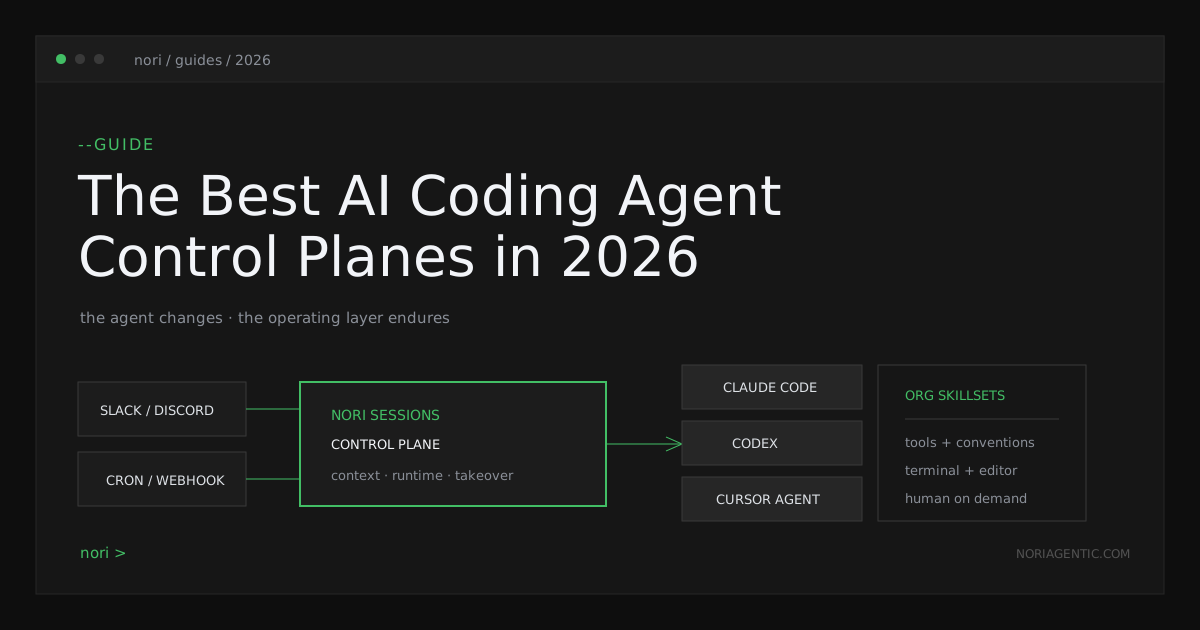
What is the best AI coding agent control plane in 2026?
It depends on how your team starts work. For a multiplayer cloud workspace with live previews across many harnesses, choose Superconductor. For desktop planning and specs with your own agent, Traycer is free. For Slack, Linear, and webhook-triggered agents with a VPC self-host option, choose Tembo. For per-minute VMs that return pull requests from Slack, Sentry, or webhooks, choose Replicas. Choose Nori Sessions for any harness on flat plans with no token charges, your own Claude or ChatGPT subscription, and Slack and Discord control.
What an AI coding agent control plane is
An AI coding agent control plane is the team layer that launches, configures, and observes coding agents across repositories. It does not write code itself. It decides where an agent runs (a cloud VM or your own machine), how work reaches it (chat, tickets, schedules, webhooks), which context it loads (skills, memories, credentials), and how people review and steer the result. It is for engineering teams running more than one agent, or more than one person’s agent, who want the same workflow regardless of which model or harness is in fashion this month.
The alternative is a single-vendor agent such as Devin, Factory, or Claude Tag, where the control plane and the agent come from the same company. That is simpler to buy, and it is the better choice when you are happy with that vendor’s agent. The cloud coding agents comparison covers those products.
Superconductor: the multiplayer cloud workspace
Superconductor runs Claude Code, Codex, Grok Build, Cursor, Pi, Muse Code, OpenCode, Amp, and Factory Droid in cloud environments, with desktop and mobile apps, live previews, custom skills, and MCP connectors. You bring API keys or an existing Claude, ChatGPT, Grok Build, or Muse Code plan. Work starts from Slack, Linear, or GitHub; automations run on a daily, weekday, or weekly schedule or when a pull request merges, which is the only GitHub event available today (Superconductor docs). As of October 2026 it is no longer free-only: Free includes a one-time 20,000 credits for up to 4 members, Pro is $100 a month with tiered credits and up to 40 members, and Enterprise is custom; 100 credits buy one hour on 1 vCPU and 2 GB (Superconductor pricing). Pick it when shared, visual review of many agents matters most.
Traycer: planning and coordination on the desktop
Traycer calls itself the “nerve center for agentic coding” and runs Claude Code, Codex, OpenCode, and Cursor side by side, keeping each task’s files, artifacts, and history together. It runs on macOS, Windows, and Linux, with a mobile app (Traycer). As of October 2026, Free is $0 with your own agent and Sync is $16 per user per month billed yearly, adding cloud sync and team collaboration; credits and cloud sandboxes cost extra. Automations are listed as coming soon with a waitlist, and no Slack integration is documented (Traycer pricing). Pick Traycer when the bottleneck is planning and alignment, not unattended execution.
Tembo: triggers and self-hosting
Tembo runs Claude Code, Codex, Cursor, and other agents. Work starts from an @Tembo mention in Slack, Linear, or a pull request comment, from a schedule or event, or through the API and webhooks, and Tembo can run on its cloud or be self-hosted in your VPC (Tembo). As of October 2026, there is a free trial for up to 10 users, Pro is $60 a month with a $60 usage allowance for up to 5 users, Max is $200 a month for up to 10 users, and Enterprise is custom; usage beyond the allowance, including VM time, is billed (Tembo pricing). Tembo is the closest peer to Nori on triggers and the better pick if you need the control plane itself inside your VPC today.
Replicas: per-minute VMs that return pull requests
Replicas, a Y Combinator company now at replicas.dev, runs Claude Code, Codex, Cursor, OpenCode, Muse Code, or Pi in a dedicated Linux VM per task. Work arrives from Slack, Linear, GitHub, GitLab, Sentry, the API, a CLI, or MCP, and automations run on a schedule or on GitHub, GitLab, Slack, Sentry, or custom webhook events. “Learnings” store team preferences that agents load automatically (Replicas, Replicas docs). As of October 2026, Developer costs $50 a month and includes the same amount of usage, Team starts at $200, and Enterprise is custom; VMs bill per minute and sleep after 30 idle minutes at no cost (Replicas billing). Pick Replicas when you want usage-based pricing and Sentry-driven fixes.
What changed since July 2026
- Coder Tasks is being retired. Coder v2.37 (September 1, 2026) deprecated Tasks in favor of Coder Agents, a fully self-hosted control plane (Coder changelog).
- Ona joined OpenAI. Ona, formerly Gitpod, announced it was joining OpenAI in June 2026 (Ona).
- Terragon wound down. Terragon shut down on February 9, 2026 (Terragon).
- Pricing moved. Superconductor added paid plans, Traycer replaced its Pro and Ultra tiers with Sync, and Tembo and Replicas published new usage-based tiers.
| Platform | Agents | Unattended triggers |
Chat control |
Self-host | Entry price |
|---|---|---|---|---|---|
| Superconductor | 9 harnesses | Schedule + PR merged | ✓ Slack | ✗ | Free credits; Pro $100/mo |
| Traycer | 4 harnesses | ✗ coming soon | ✗ | ✗ | Free; Sync $16/user/mo |
| Tembo | Claude Code, Codex, Cursor, more | ✓ schedule + webhook | ✓ Slack | ✓ your VPC | Pro $60/mo |
| Replicas | 6 harnesses | ✓ schedule + webhook | ✓ Slack | ✗ | Developer $50/mo + per minute |
| Nori Sessions | Any harness or ACP agent | ✓ cron + webhook | ✓ Slack + Discord | Enterprise | Developer $99/mo; no token charges |
Publicly documented capabilities and list prices as of October 2026. “Self-host” means running the platform on your own infrastructure. See vendor sources below.
How to choose an AI coding agent control plane
- Choose the layer, not the model. A control plane should survive your next agent switch. Check which harnesses it runs today.
- Check how work starts. Schedules and webhooks belong in the product. Superconductor supports only one GitHub event, and Traycer has no automations yet.
- Meet the team in chat. Slack is common. Discord support is rarer; Nori is the only product here that documents it.
- Carry context forward. Look for skills, memories, or learnings that load into every fresh environment.
- Decide where it must run. If the platform itself must sit in your VPC today, Tembo is the strongest pick here.
- Model the bill. Credits, usage allowances, per-minute VMs, and token charges add up differently. Price a busy month.
Where Nori Sessions fits
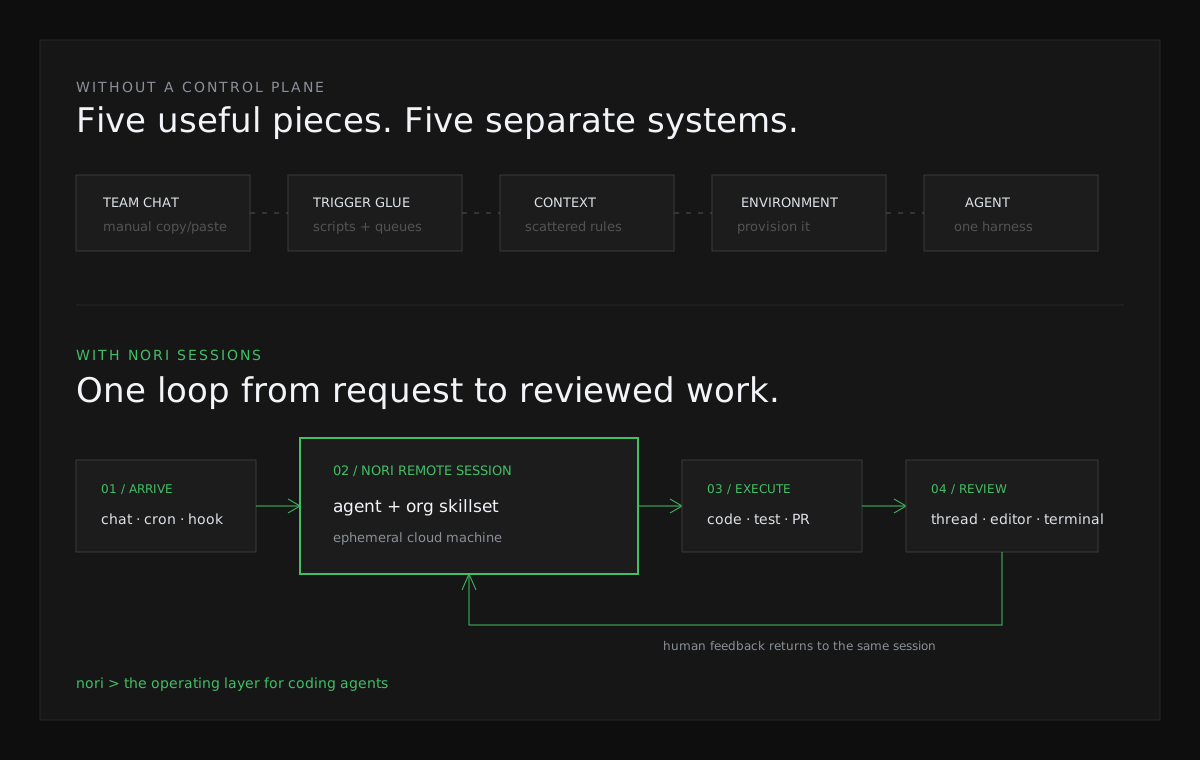
Nori Sessions is a control plane and runtime for any coding agent, priced as flat plans rather than usage:
- Any harness. Claude Code, Codex, Gemini CLI, Cursor, OpenCode, Droid, Amp, Goose, or any ACP agent.
- Your own model access. Bring your Claude or ChatGPT subscription, API keys, or an LLM gateway. Nori never charges for tokens, so there is no markup and incentives stay aligned.
- Every surface. Slack, Discord, the web, and the CLI.
- Automations. Cron and webhook triggers launch sessions with nobody attached.
- Opinionated defaults. Workflow skills, org skillsets, and memories load into every session.
- Enterprise. Bring your own compute, identity provider (SAML, SCIM, OIDC), LLM gateway, token provider, and memory provider, in your cloud or on-prem.
As of October 2026: a free 30-day trial (5 runtimes, no card), Developer at $99 a month, Team at $250 a month, and custom Enterprise. Teams have merged more than 100,000 pull requests with Nori. If you want a hosted control plane in your VPC without an Enterprise contract, Tembo is the better fit; if you want shared visual review, Superconductor is.
Subscribe to the newsletter
Weekly updates and long-form essays from the Nori team on AI agents and the agent ecosystem.
The bottom line
A coding agent is a worker; the control plane is how a team manages the workers. Superconductor leads on collaboration, Traycer on planning, Tembo on triggers plus self-hosting, and Replicas on usage-based VMs. Nori Sessions combines any harness, your own model subscriptions, Slack and Discord, and cron and webhook automations on a flat price. Try Nori Sessions free for 30 days.
Frequently asked questions
How is a control plane different from a coding agent?
A coding agent writes and tests code. A control plane decides where that agent runs, how work reaches it, which context it receives, who can steer it, and how the team reviews the result. Superconductor, Traycer, Tembo, Replicas, and Nori Sessions all run more than one agent.
Which coding agent control planes support schedules and webhooks?
As of October 2026, Tembo, Replicas, and Nori Sessions document both schedules and webhook triggers. Superconductor supports schedules plus a pull-request-merged GitHub event. Traycer lists automations as coming soon.
Do AI coding agent control planes work from Slack?
Superconductor, Tembo, Replicas, and Nori Sessions document Slack. Traycer does not. Nori Sessions also supports Discord, the web, and a CLI.
Can I self-host a coding agent control plane?
Tembo can be self-hosted in your VPC. Coder Agents is fully self-hosted, including air-gapped networks. Nori Sessions offers bring-your-own compute in your cloud or on-prem on its Enterprise plan. Superconductor, Traycer, and Replicas do not document self-hosting.
How much does an AI coding agent control plane cost?
As of October 2026: Superconductor Pro is $100 a month with credits, Traycer Sync is $16 per user per month billed yearly, Tembo Pro is $60 a month with a usage allowance, and Replicas Developer is $50 a month, with usage billed per minute. Nori Sessions is Developer $99 a month or Team $250 a month, with a free 30-day trial and no token charges.
Sources
Vendor pages were read on October 19, 2026 unless noted.
- Superconductor — pricing
- Superconductor — docs: agents, subscriptions, automations
- Traycer — product
- Traycer — pricing
- Tembo — product, triggers, and deployment
- Tembo — pricing
- Replicas — product
- Replicas — docs index
- Replicas — billing
- Coder — v2.37 changelog (Tasks deprecated, Coder Agents GA)
- Ona — joining OpenAI
- Terragon — shutdown notice
- Nori Sessions — product and pricing