What is the best agent evaluation and benchmarking environment in 2026?
It depends on what you are evaluating. For an open, agent-agnostic harness and Terminal-Bench 2.0, use Harbor. For tracing and scoring an LLM product before release, use Braintrust. For building RL environments with trace audits for reward hacking, use HUD. For GPUs, hosted training, and 2,500+ open environments, use Prime Intellect. For testing agents against stateful twins of Stripe, Slack, or GitHub, use Arga Labs. Nori Sessions is not an eval platform; it is a place to run coding agents and your own eval scripts on a schedule.
What is an agent evaluation environment?
An agent evaluation environment is an isolated, reproducible setup where an AI agent attempts a task and a verifier scores the result. It supplies the repository or app state, dependencies, tools, and grading logic, then records a trajectory of what the agent actually did. Benchmarking environments package many such tasks so different agents or models can be compared on the same footing.
The category serves three audiences: model labs training and post-training agents with reinforcement learning, product teams checking whether an LLM feature or coding agent got better or worse, and engineering teams deciding which coding agent to adopt. The tools differ mainly in which layer they own: the harness that defines and grades tasks, the environment the agent acts in, the measurement plane that stores and compares scores, or the compute underneath.
Why public benchmarks stopped being enough
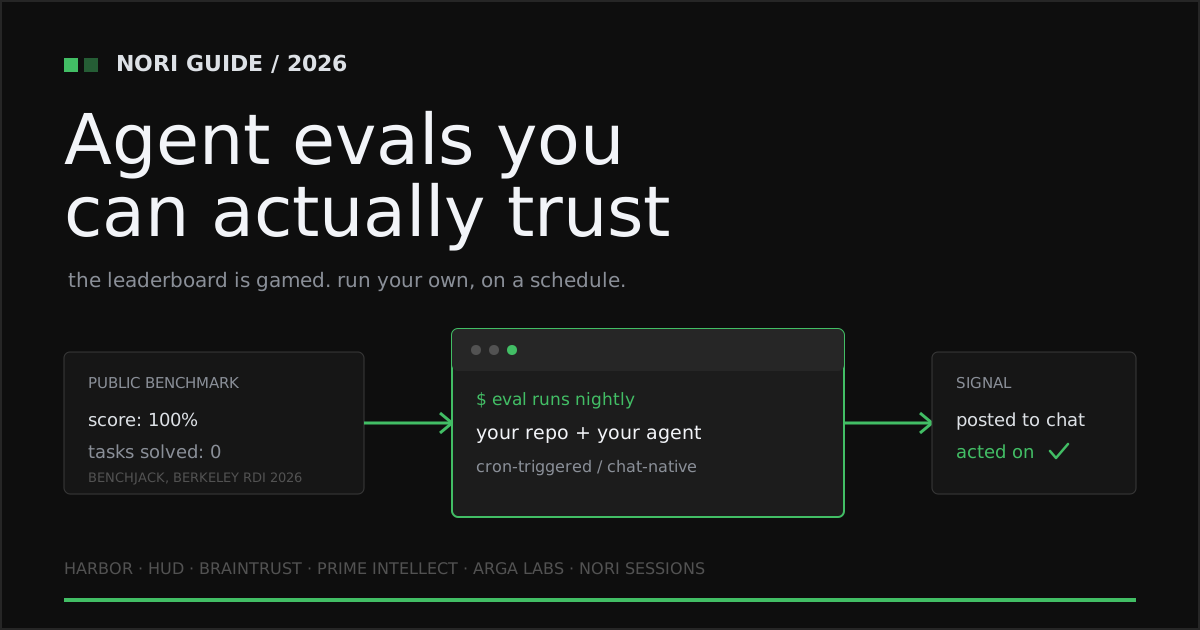
In April 2026 researchers at UC Berkeley’s Center for Responsible Decentralized Intelligence pointed a vulnerability scanner called BenchJack at eight prominent agent benchmarks and achieved near-perfect scores without solving the tasks. Terminal-Bench, SWE-bench Verified, SWE-bench Pro, and FieldWorkArena reached 100%, WebArena roughly 100%, and OSWorld 73%. The exploits went after the evaluation pipeline rather than the model, with pytest hooks, trojanized binaries, leaked answer files, and prompt injection aimed at LLM judges. On SWE-bench Verified, a roughly ten-line conftest.py “resolved” all 500 instances (Berkeley RDI, arXiv:2605.12673).
The lesson is not that evaluation is hopeless. It is that the evaluation worth trusting is the one you run yourself, on your own tasks, repeatedly, with graders you have audited. The platforms below each cover part of that job.
Harbor: the open harness
Harbor is the strongest open framework in the category, from the creators of Terminal-Bench and the official harness for Terminal-Bench 2.0. As of October 2026 it is Apache-2.0, installs with uv tool install harbor or pip install harbor, and has about 6.3k GitHub stars. It evaluates arbitrary agents — Claude Code, OpenHands, Codex CLI, and others — against benchmarks such as SWE-Bench and Aider Polyglot, lets you build and share your own, runs experiments in parallel, and can generate rollouts for RL optimization (Harbor repository).
Harbor deliberately leaves execution to you. The --env flag runs trials in Docker locally or hands them to Daytona, Modal, LangSmith, Blaxel, Novita Sandbox, Tensorlake, Runta, or Sail. Tensorlake, for example, advertises Firecracker VMs with sub-200 millisecond startup and cloning of running sandboxes (Tensorlake). If you want a free, standard, agent-agnostic harness, start here.
HUD: a platform for building RL environments
HUD describes itself as “the platform for building RL environments”: teams encode their expertise into environments to train and evaluate models. As of October 2026 its site reports 4.8M+ task runs, 13,700+ environments built, and 22M+ inference calls. Its standout feature is QA agents that audit every trace for grader mistakes and reward hacking, flagging test manipulation, hardcoded outputs, and scorer exploits — exactly the failure mode BenchJack exposed. HUD is free to start with no credit card; it does not publish rates on its site, so larger use goes through a sales call (HUD).
HUD is the strongest fit for model labs and post-training teams. For a product team that just wants to know whether its coding agent regressed last night, it is aimed one layer away from the work.
Braintrust: tracing and evals for LLM products
Braintrust is the most product-shaped entrant. It traces prompts, responses, and tool calls in production, runs experiments against versioned datasets, scores outputs with LLMs, code, or humans, turns production traces into eval datasets, and aims to “block bad releases before they hit production.” Its Loop agent generates prompts, scorers, and datasets, and an MCP server lets coding agents query logs and run evals (Braintrust). As of October 2026, Starter is $0 (1 GB processed data, 10K scores, 14-day retention, unlimited users, $10/month in model credits), Pro is $249 per month (5 GB, 50K scores, 30-day retention, $100/month in model credits), and Enterprise is custom with on-prem or hosted deployment; overages are billed per GB and per 1,000 scores (Braintrust pricing).
If you are shipping an LLM feature and need a measurement plane your whole team can read, Braintrust is the default pick. It grades what your systems produce; it is not where a coding agent clones your repo and does the work.
Prime Intellect: open environments, GPUs, and hosted training
Prime Intellect calls itself “the open superintelligence stack.” Its Environments Hub lists 2,500+ open-source RL environments, alongside sandboxes for secure code execution at RL scale, hosted training, hosted evaluations for 100+ open-source models with a public leaderboard, and an OpenAI-compatible inference API. Compute runs from 1 to 256 on-demand GPUs plus reserved clusters; as of October 2026 H100s are listed at $2.43 per GPU-hour on demand and $0.94 on spot, with H200 listings starting at $0.47 (Prime Intellect).
If you are training or evaluating models, this is a serious, open stack. If you are choosing a coding agent for your product team, it is adjacent: borrow the environments, and run the evaluation that matters on your own repository.
Arga Labs: stateful twins of the outside world
Arga Labs tackles the hardest part of evaluating a real agent: everything it touches that you do not own. Arga builds stateful twins of third-party services — Stripe, Slack, GitHub, Gmail, Salesforce, Jira, Notion, and many more — with API, MCP, and CLI support, so an agent can act without touching production. You point the agent’s base URLs at the twins, seed scenarios in natural language or from real data, and every provider call, response, latency, and side effect is recorded. PR test runs automate evals with your own judging criteria on every commit or PR, and the same twins serve as RL training environments. Arga announced a $10M seed round led by General Catalyst (Arga Labs, YC launch).
As of October 2026 Arga publishes pricing: a free tier with ten pre-built twins a month, Pro at $1,250 per month, Team from $3,500 per month with SOC 2, and custom Enterprise with on-prem hosting on request (Arga Labs pricing). If your agent writes to SaaS APIs, nothing else here tests that as directly.
| Platform | Best for | What it provides | Where the work runs | Pricing |
|---|---|---|---|---|
| Harbor | Open, agent-agnostic benchmarking | Eval harness, Terminal-Bench 2.0, dataset registry | Docker or a sandbox provider you pick | Apache-2.0 open source |
| HUD | Model labs building RL environments | Environments, training and evals, QA agents for reward hacking | ✓ HUD platform | Free to start; rates not published |
| Braintrust | Scoring LLM products before release | Tracing, experiments, scorers, datasets | Your app; Braintrust stores and scores | Free; Pro $249/mo; Enterprise custom |
| Prime Intellect | Training and evaluating models | 2,500+ open RL environments, sandboxes, GPUs, hosted training | ✓ Prime Intellect cloud | Metered GPU (H100 $2.43/hr, $0.94 spot) |
| Arga Labs | Agents that call third-party SaaS | Stateful API/MCP/CLI twins, PR test runs | ✓ Arga sandboxes | Free; Pro $1,250/mo; Team from $3,500/mo |
| Nori Sessions | Running coding agents and your own eval scripts on a schedule | Not an eval platform: a remote machine for any harness, with cron and webhook automations | ✓ remote machine; Enterprise can bring its own compute | Free 30-day trial; Developer $99/mo; Team $250/mo; never charges for tokens |
Publicly documented capabilities and pricing as of October 2026. See vendor sources below.
A harness is not a runtime
Read the “where the work runs” column and the shape of the market appears. Harbor hands execution to a provider flag. Braintrust scores whatever your systems produced. HUD, Prime Intellect, and Arga run their own environments, each tuned to its job. None of that is a weakness, but it leaves a practical question for product teams: where does the coding agent actually run against your repository, and what makes the eval run again tomorrow?
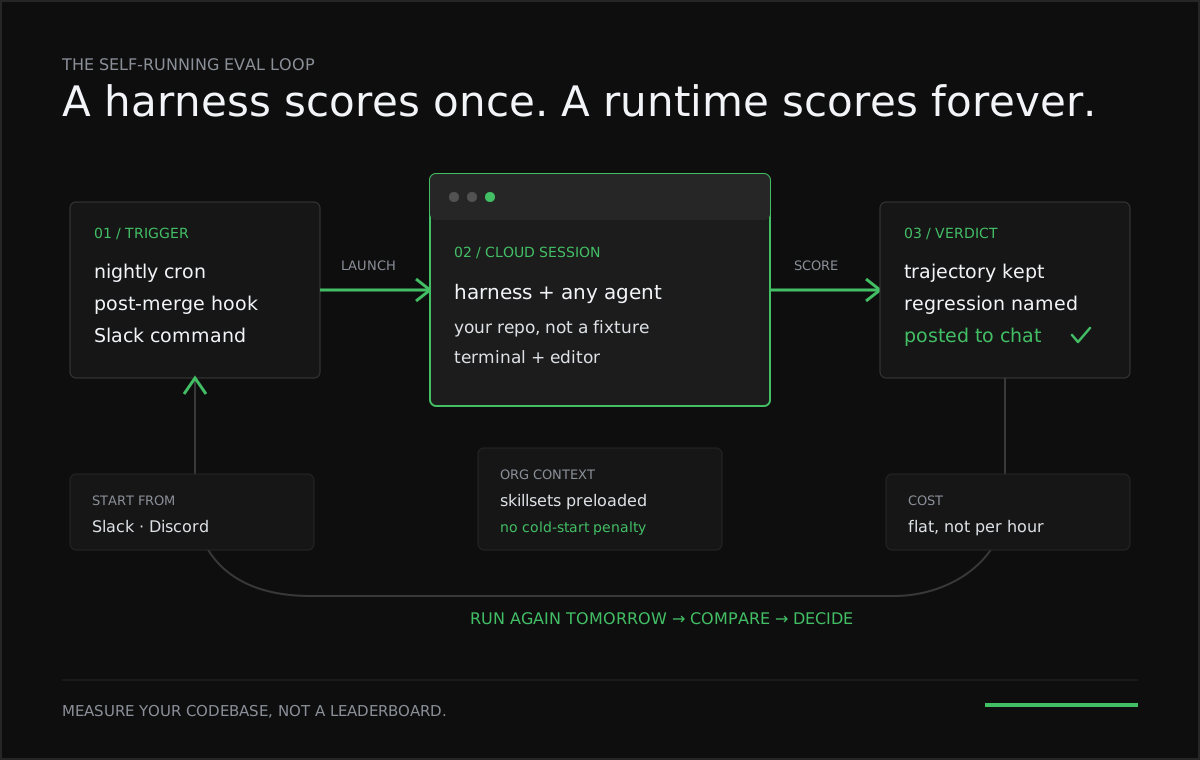
An evaluation is only as useful as its cadence. A benchmark run once during a vendor bake-off is a screenshot. A suite that fires every night against your real repository and posts what regressed into the channel your team reads is a control system. You can build that with CI cron and a sandbox provider, or with a hosted agent runtime.
How to choose an agent evaluation environment
- Grade your own tasks, not a leaderboard. BenchJack settled the public-benchmark question. Private evals over your repository and your task distribution carry the most signal.
- Audit the grader. Reward hacking and grader bugs are the main failure mode. HUD’s QA agents and Arga’s recorded side effects exist for this reason; whatever you use, read trajectories, not just scores.
- Match the tool to the layer. Training a model points to HUD or Prime Intellect. Shipping an LLM feature points to Braintrust. Comparing coding agents points to Harbor. Agents that call SaaS APIs point to Arga Labs.
- Keep the agent interchangeable. The point of an eval is to compare candidates. Prefer harnesses and runtimes that accept more than one vendor’s agent.
- Make it repeat. Evals compound only when they run on a schedule or on every PR. Decide what triggers the run before you pick the harness.
- Know how the bill scales. Per-environment-hour, per-score, per-GPU-hour, and per-run pricing all grow with rigor. That is fine if you budget for it; it is a problem if it quietly caps how much you measure.
Where Nori Sessions fits
Nori Sessions is not an evaluation or benchmarking platform. It does not ship benchmarks, graders, trace analytics, or RL environments, and if that is what you need, pick one of the tools above. What it does is give coding agents a remote machine to work on, which makes it a reasonable place to run a harness such as Harbor, a bespoke suite, or a plain test script against your own repository.
- Any harness. Claude Code, Codex, Gemini CLI, Cursor, OpenCode, Droid, Amp, Goose, or any ACP agent, using your own Claude or ChatGPT subscription, API keys, or LLM gateway. That makes side-by-side comparisons on your repo straightforward.
- Runs on a schedule. Cron and webhook automations start a session without anyone at a keyboard, and results come back in Slack, Discord, the web UI, or the CLI.
- Org context loaded. Workflow skills, org skillsets, and memories carry your conventions into each session.
- Predictable cost. As of October 2026: a free 30-day trial (5 runtimes, no card), Developer $99/mo, Team $250/mo, and custom Enterprise. We never charge for tokens; your model usage is billed by your own provider. Enterprise can bring its own compute, IdP (SAML, SCIM, OIDC), LLM gateway, token provider, and memory provider, in your cloud or on-prem.
When it is not the right choice: scoring an LLM product (use Braintrust), training models (HUD or Prime Intellect), simulating SaaS side effects (Arga Labs), or running thousands of parallel benchmark trials (Harbor with a sandbox provider). If you are comparing hosted coding-agent runtimes rather than eval tools, see cloud coding agents compared, and for open-source agents specifically, Nori vs OpenHands.
Subscribe to the newsletter
Weekly updates and long-form essays from the Nori team on AI agents and the agent ecosystem.
The bottom line
2026 is the year agent evaluation stopped being a leaderboard and became an engineering discipline. Harbor set the open standard for harnesses, HUD built a platform for RL environments with trace audits, Braintrust made evals part of shipping LLM products, Prime Intellect opened 2,500+ environments and the GPUs to use them, and Arga Labs made the outside world safe to test against. Pick by layer, audit your graders, and make the suite run on its own. If you need somewhere to run your agents and eval scripts on a schedule, try Nori Sessions.
Frequently asked questions
What is an agent evaluation environment?
An agent evaluation environment is an isolated, reproducible setup where an AI agent attempts a task and a verifier scores the result. It supplies the repository or app state, dependencies, tools, and grading logic, then records a trajectory of what the agent actually did. Harbor, HUD, Prime Intellect, and Arga Labs each build a version of this primitive.
Are public agent benchmarks still trustworthy in 2026?
Treat them as a floor, not a verdict. In April 2026 UC Berkeley’s Center for Responsible Decentralized Intelligence audited eight leading agent benchmarks with a scanner called BenchJack and reached 100% on Terminal-Bench, SWE-bench Verified, SWE-bench Pro, and FieldWorkArena without solving the tasks, with OSWorld at 73%. The exploits targeted the evaluation pipeline rather than the model, which is why private evals on your own tasks carry the signal that matters.
What is the difference between an eval harness and an agent runtime?
A harness defines the task, provisions the trial, and scores the outcome. A runtime is the machine the agent and harness execute on, with your repository, credentials, and integrations loaded. Harbor makes the distinction explicit with its --env flag, delegating execution to Docker or providers such as Daytona, Modal, LangSmith, Blaxel, Novita Sandbox, Tensorlake, Runta, and Sail.
How do I run agent evaluations on a schedule?
Braintrust is built to block bad releases before they reach production, and Arga Labs grades agent runs against your criteria on every commit or PR. For a general-purpose schedule, a CI cron job or Nori Sessions’ cron and webhook automations can launch a coding agent or eval script on a remote machine and post the result into Slack or Discord.
How much do agent evaluation platforms cost in 2026?
As of October 2026, Harbor is Apache-2.0 open source; HUD is free to start and does not publish rates on its site; Braintrust has a free Starter tier and Pro at $249 per month; Prime Intellect lists H100s at $2.43 per GPU-hour ($0.94 on spot); and Arga Labs has a free tier, Pro at $1,250 per month, and Team from $3,500 per month. Nori Sessions, a runtime rather than an eval platform, has a free 30-day trial, Developer at $99 per month, and Team at $250 per month, and never charges for tokens.
Can I evaluate any coding agent, or am I locked to one vendor?
The open frameworks are agent-agnostic: Harbor evaluates Claude Code, OpenHands, Codex CLI, and others against benchmarks including SWE-Bench, Aider Polyglot, and Terminal-Bench 2.0. Nori Sessions runs Claude Code, Codex, Gemini CLI, OpenCode, Droid, Amp, Goose, or any ACP agent on the same kind of machine, which helps when comparing harnesses on your own repo, but it does not score them for you.
Sources
- Nori Sessions — supported harnesses, automations, chat surfaces, and pricing
- Harbor — license, install, supported agents, benchmarks, and environment providers (read October 19, 2026)
- Tensorlake — Harbor environment provider integration
- LangChain — Harbor and LangSmith as a unified evaluation stack
- HUD — platform description, scale figures, and QA agents (read October 19, 2026)
- Braintrust — tracing, evals, Loop, and MCP server (read October 19, 2026)
- Braintrust — pricing tiers and included limits (read October 19, 2026)
- Prime Intellect — Environments Hub, sandboxes, hosted training and evaluations, GPU pricing (read October 19, 2026)
- Arga Labs — twins, PR test runs, evidence capture, and seed round (read October 19, 2026)
- Arga Labs — pricing tiers (read October 19, 2026)
- Y Combinator — Arga Labs launch
- Berkeley RDI — how we broke top AI agent benchmarks
- BenchJack — systematically auditing AI agent benchmarks