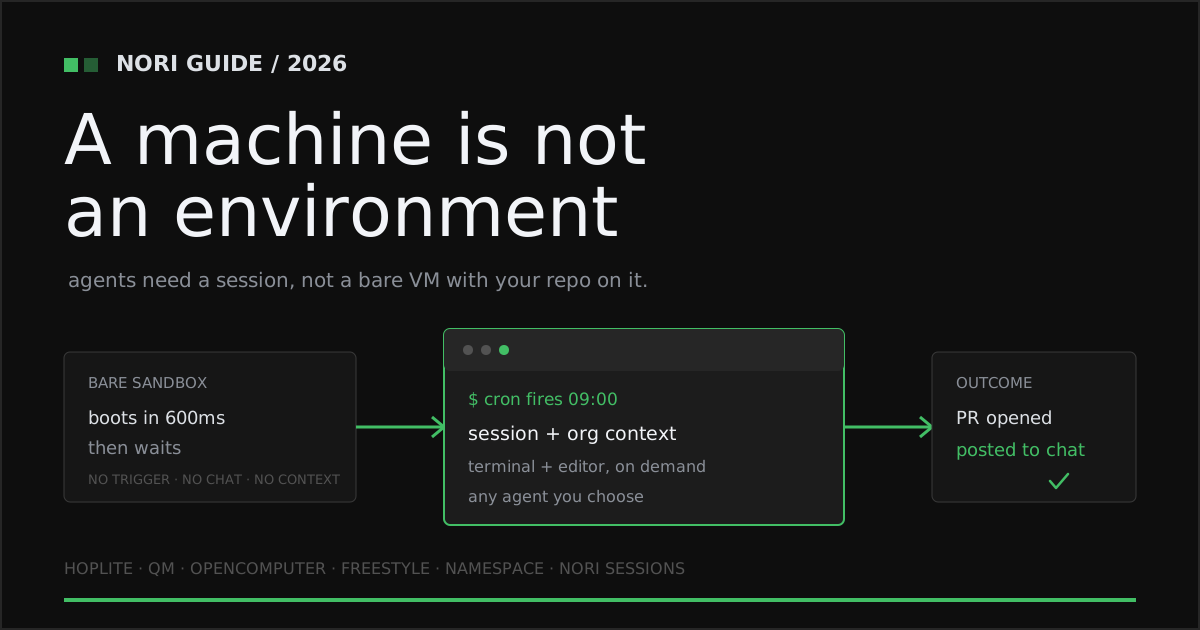
What is the best agent-first cloud dev environment in 2026?
It depends on which layer you need. If you are building your own agent product, start with Freestyle for fast VMs and hosted Git, or OpenComputer for long-running VMs. If people and agents should share managed devboxes, including macOS, use Namespace Devbox. For a hosted agent that turns tasks into pull requests from Slack or Linear, try Hoplite. To self-host a Slack-native agent harness for free, deploy QM. Nori Sessions fits teams that want any harness, their own model subscriptions, and Slack, Discord, cron, and webhook triggers on flat plans.
What is an agent-first cloud dev environment?
An agent-first cloud dev environment is a remote machine, plus the tooling around it, built for a coding agent as the primary occupant rather than a human at an editor. It is for engineering teams that want agents to do real work — fix bugs, upgrade dependencies, run tests, open pull requests — in isolation from laptops and production. What it does: boots a machine on demand with your repository and credentials, lets the agent install, run, and break things safely, and gives the run a way to start and report back without anyone sitting in front of it.
For fifteen years “cloud dev environment” meant moving a human’s laptop into a data center. Agents want something different. They need a machine in seconds, not a low-latency editor. They fork instead of working one branch at a time. They run overnight. And they do not open a laptop to get started — something has to start them. The products below split along that line: some sell the machine, some sell the trigger and the conversation around it, and a few sell both. If you are comparing full cloud coding agents (Devin, Factory, Cursor, Claude Tag, Amp, Warp, OpenHands) rather than environments, see our cloud coding agents comparison.
Freestyle: the fastest primitive in the category
Freestyle is the sharpest pure compute play here. As of October 2026 its homepage promises “a full Linux machine, ready in 65 ms,” live cloning that lets you “copy a running VM, memory included,” pause and resume “with your state intact,” and nested virtualization so you can “run Docker and VMs inside your VM” (Freestyle).
The second product is the more original idea. Freestyle Git is hosted Git for products that manage code on behalf of users or agents: create repositories by API, grant scoped per-agent access, inspect and search code without a checkout, attach automation triggers on push, and sync with GitHub (Freestyle Git docs).
Pricing as of October 2026: a free tier (up to 10 concurrent VMs), Hobby at $50 a month, Pro at $500 a month, and Enterprise custom. Paid plans cover usage up to the plan amount, then bill per vCPU-hour ($0.04032), GiB-hour of memory ($0.0129), storage, and transfer (Freestyle pricing).
Freestyle is an SDK for people building agent products. It hands you a superb machine and a Git primitive, then leaves who may start a run, when it starts, what the agent knows about your company, and where the result lands to you. If you are building a platform, it is the best place to start.
OpenComputer: persistent VMs, now with hosted agents
OpenComputer, from the Digger team (diggerhq/opencomputer), bets that agent work needs machines that stay up. It describes itself as “persistent cloud VMs for AI agents. Beyond sandboxes.” Every machine has “a full filesystem, full OS access, and persistent state”; it “stays always on,” and you can resize memory and CPU at runtime or hibernate and wake it later. Checkpoints give “instant snapshots. Fork or restore to any point” (OpenComputer).
Since July it has also moved up a layer: you can deploy a TypeScript agent (for example, one built on the Claude Agent SDK) as a managed service with durable sessions, schedules, webhooks, memory across sessions, and Slack, GitHub, and Linear connections. That is a real trigger layer, but it runs agents you write rather than off-the-shelf coding agents.
Pricing has changed from July’s per-minute meter to capacity tiers. As of October 2026: Free (shared up to 2 vCPU, 2 GB memory, 3 GB disk, 5 concurrency), Medium at $300 per month (8 CPU, 16 GB memory, 50 GB disk, 50 concurrency), Large at $3,000 per month (64 CPU, 512 GB memory, 500 concurrency), and custom.
Namespace Devbox: the managed workspace, for both occupants
Namespace Devbox offers “managed Linux and macOS development environments for people and AI coding agents,” and it is the most polished operational experience in this group. Linux devboxes run from a container image you choose and include Docker; macOS devboxes run on Apple Silicon with a choice of macOS and Xcode versions. They are reachable over SSH or from your local IDE, including VS Code, Cursor, JetBrains, and Zed, and files persist across stop and start (Namespace Devbox docs). Agent CLIs including Amp, Claude Code, Codex, Copilot, Cursor, and OpenCode can run inside a devbox.
Namespace also serves as execution infrastructure for other agents. Cursor cloud agents can run on Namespace Devboxes, where “Cursor handles orchestration” in its cloud and “Namespace handles execution” on a fresh devbox per session (Namespace Cursor integration; see Nori vs Cursor cloud agents), and Devin’s Outposts list Namespace as a supported machine host (see Nori vs Devin).
Pricing as of October 2026: devboxes bill $0.004 per Devbox Minute, so Linux sizes S, M, L, and XL cost $0.004, $0.008, $0.016, and $0.032 per minute; macOS M and L cost $0.06 and $0.12 per minute. Storage is $0.20 per GB-month used, and an idle devbox shuts down after 15 minutes. Devbox Plus is $250 per month with 50,000 Devbox Minutes included (Namespace pricing). Namespace itself does not ship a scheduler or chat surface for dispatching agents; that comes from whichever agent you pair it with.
Hoplite: the full-service agent
Hoplite sells the outcome. It offers “cloud coding agents that work in isolated development environments, verify their changes, and open pull requests.” Each task runs in a thread with its own environment wired to a GitHub repository with a setup script and encrypted environment variables, and you keep iterating in that thread as review feedback arrives (Hoplite).
Hoplite has filled in the control layer since July. As of October 2026, automations turn cron schedules and incoming webhooks into agent work, with a 5-minute minimum interval on paid plans (Hoplite automations), and integrations cover Slack (route channels to projects), Linear (mentions and delegated issues), Sentry, Axiom, MCP servers, and even iMessage (Hoplite integrations). If you want a hosted agent that a team can dispatch from Slack and Linear with minimal setup, Hoplite is a strong pick.
Pricing has also changed. As of October 2026 the pricing page lists Free ($0, 5 concurrent cloud sessions), Team at $60 per seat per month (or $600 per seat per year billed annually) with 50 concurrent sandboxes per seat, and custom Enterprise with contractual SLAs and an architecture review (Hoplite pricing). July’s Pro and Scale tiers are no longer listed. Hoplite does not publicly document which agent harnesses or bring-your-own model subscriptions it supports.
QM: the self-hosted option
QM (Quartermaster), published under the yc-software GitHub organization, is “a multiplayer agent harness for work. In Slack and on the web,” designed so you can “run it in your own cloud, with your own models and keys.” “Each person and each room has its own scoped memory, files, keychain view, permissions, crons, web apps, and durable sandbox.” Background work runs on crons, watches, and inbound webhooks, skills are shareable with admin-gated promotion to the whole org, and “Pi and Claude Code both drive the same core.” It is MIT licensed (QM repository).
One line decides whether it is right for you: “Each deployment runs in the operator’s own cloud account.” QM is software you deploy and operate — sandboxes, identity, the Slack app, upgrades, and the pager. If you have the platform team for that and want zero license cost, it is the best free option here. The README also points to a third-party hosted version.
| Platform | What you get | Unattended (cron / webhook) | Chat-native control | Durable org context | Pricing model |
|---|---|---|---|---|---|
| Freestyle | VM + hosted Git SDK for agents | Git push triggers; you build the rest | ✗ | ✗ | Free; Hobby and Pro plans; usage beyond plan |
| OpenComputer | Persistent VMs, snapshots + hosted agents you write | ✓ schedules + webhooks for deployed agents | Slack connection for deployed agents | Memory across sessions | Free; $300/mo; $3,000/mo; custom |
| Namespace Devbox | Managed Linux + macOS devboxes, IDE + SSH | ✗ via paired agent | ✗ via paired agent | Container image | $0.004–$0.032 / minute (Linux) + storage |
| Hoplite | Managed agent, task to reviewed PR | ✓ cron + webhook | ✓ Slack, Linear, iMessage | Setup scripts + env vars | Free; Team $60 / seat / month |
| QM (Quartermaster) | Multiplayer agent harness, self-hosted | ✓ crons, watches, webhooks | ✓ Slack + web | ✓ scoped memory + shared skills | MIT; you run the infrastructure |
| GitHub Codespaces | Human-first cloud dev environment | ✗ | ✗ | devcontainer.json | $0.09 / core-hour + $0.07 / GB-mo |
| Nori Sessions | Managed sessions running any agent harness | ✓ cron + webhook | ✓ Slack, Discord, web, CLI | ✓ org skillsets + memories | Free 30-day trial; $99/mo; $250/mo; never charges for tokens |
Publicly documented capabilities and pricing as of October 2026. See vendor sources below.
A machine is not an environment
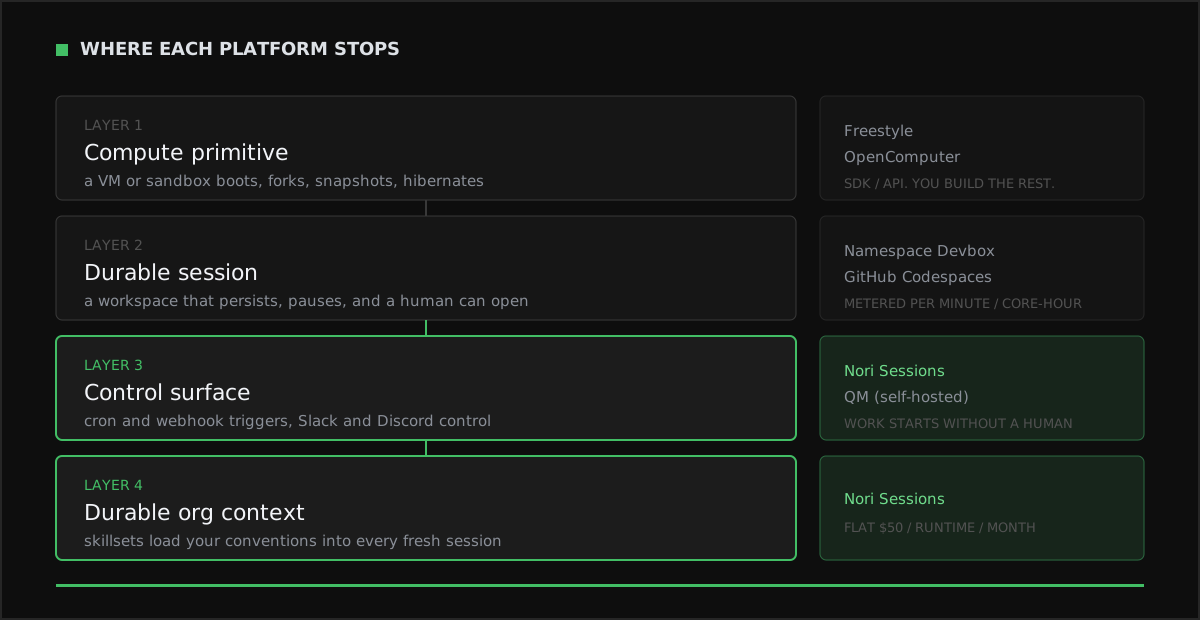
Stack the category up and it resolves into four layers. Layer one is the compute primitive: a VM that boots, forks, snapshots, hibernates. Layer two is a durable workspace a human can actually open. Layer three is the control surface — the triggers and chat entry points that decide when work happens and who can ask for it. Layer four is durable org context: the conventions, tooling, and workflows that load automatically so a fresh machine is not a blank one.
In July most entrants competed on layers one and two. By October 2026 the line has moved: Hoplite and OpenComputer added schedules and webhooks, and QM ships all four layers as self-hosted software. The remaining differences are about who runs it, which agents it runs, and how you pay.
How to choose an agent-first cloud dev environment
- Decide whether you are building or buying. If agents are your product, buy a primitive (Freestyle, OpenComputer). If agents are a tool for your team, buy or deploy a platform (Hoplite, QM, Nori Sessions).
- Ask what starts the work. If the answer is “a person opens something,” you have bought a workspace, not an environment. Look for cron and webhook triggers as a first-class feature, not a script you maintain.
- Put the control surface where your team already talks. An agent you dispatch from Slack gets used by everyone. An agent behind a separate dashboard gets used by the person who set it up.
- Insist that context travels. Ephemeral machines are only an advantage if each fresh one already knows your standards and tooling.
- Keep the agent interchangeable. Model and harness quality move every quarter. An environment that runs any agent lets you switch; a platform that is the agent makes that switch a migration.
- Match the pricing model to the workload. Per-minute compute suits bursty jobs; per-seat suits a fixed team of requesters; flat plans suit heavy unattended use. Check whether model tokens are billed by the vendor or by your own provider account.
Where Nori Sessions fits
Nori Sessions is a managed environment where each session is a cloud machine that boots with your repository, credentials, and integrations, runs the coding agent you choose, and reports back where your team works. Teams have merged 100,000+ pull requests through it.
- Any harness. Claude Code, Codex, Gemini CLI, Cursor, OpenCode, Droid, Amp, Goose, or any ACP agent. When the leaderboard shifts, you change a setting, not a vendor.
- Your models, your bill. Bring your own Claude or ChatGPT subscription, API keys, or LLM gateway. We never charge for tokens: no markup, no provider lock-in, and our incentives stay aligned with yours.
- The work starts itself. Cron and webhook automations, plus Slack, Discord, the web UI, and the CLI as entry points.
- Opinionated defaults. Workflow skills, org skillsets, and memories load into each fresh session so it starts informed.
- Enterprise on your terms. Bring your own compute, IdP (SAML, SCIM, OIDC), LLM gateway, token provider, and memory provider, in your cloud or on-prem.
Pricing as of October 2026: a free 30-day trial (5 runtimes, no card), Developer at $99 per month, Team at $250 per month, and custom Enterprise.
When Nori Sessions is not the right choice: if you are building your own agent product and need an API-first VM or Git primitive, use Freestyle or OpenComputer. If you want IDE-attached devboxes for people, or macOS machines, Namespace Devbox is the better fit. If you want a free, self-hosted Slack harness and have the team to run it, QM costs nothing to license. And if you want a single hosted agent with Linear and Sentry integrations rather than a choice of harnesses, Hoplite is worth a trial. For head-to-heads against full cloud coding agents, see Nori vs Factory, Nori vs Amp Orbs, and Nori vs OpenHands.
Subscribe to the newsletter
Weekly updates and long-form essays from the Nori team on AI agents and the agent ecosystem.
The bottom line
2026 is the year the cloud dev environment stopped being a laptop in a data center. Freestyle made the primitive fast, OpenComputer made it persistent, Namespace made it operable for people and agents alike, Hoplite packaged the whole task, and QM put the full architecture in the open. Pick by layer: the primitive if you are building, the workspace if people are in the loop, and a platform if you want agents doing work while nobody is watching. Try Nori Sessions free for 30 days.
Frequently asked questions
What is an agent-first cloud dev environment?
An agent-first cloud dev environment is a remote machine, plus the tooling around it, built for a coding agent as the primary occupant rather than a human at an editor. It boots on demand, carries your repository and credentials, isolates the work so an agent can install, run, and break things safely, and gives the run a way to start and report without anyone sitting in front of it. As of October 2026, Freestyle, OpenComputer, Namespace Devbox, Hoplite, QM, and Nori Sessions each cover a different share of that stack.
How is an agent-first environment different from a cloud IDE?
A cloud IDE assumes a person is present and optimizes for editor features and a workday-length session. An agent-first environment assumes nobody is watching, so it optimizes for fast provisioning, forking, snapshotting, and unattended start. As of October 2026, GitHub Codespaces bills $0.09 per core-hour of compute plus $0.07 per GB-month of storage, while Freestyle advertises “a full Linux machine, ready in 65 ms” and live cloning of a running VM with its memory.
Do I need a sandbox API or a full agent platform?
A sandbox API gives you a compute primitive and expects you to build scheduling, chat, permissions, and context loading yourself. A platform ships those layers. Freestyle is a primitive; OpenComputer is a primitive that can also host agents you write; Namespace Devbox is a managed workspace; Hoplite, QM, and Nori Sessions ship triggers and Slack control. Pick a primitive if you are building your own agent product, and a platform if you want your team using agents this week.
Can coding agents run on a schedule without a person starting them?
Yes, if the environment has a trigger layer. As of October 2026, Hoplite runs automations from cron schedules and incoming webhooks, QM supports crons, watches, and inbound webhooks per person and room, OpenComputer lets agents you deploy run on schedules and webhooks, and Nori Sessions ships cron and webhook automations that claim a fresh cloud machine, do the work, and report back into Slack or Discord. Pure sandbox APIs leave scheduling to code you write and operate.
How much do agent-first cloud dev environments cost in 2026?
As of October 2026: Freestyle has a free tier, Hobby at $50 a month, and Pro at $500 a month, with usage beyond the plan amount billed per vCPU-hour, memory, storage, and transfer. OpenComputer lists Medium at $300 per month and Large at $3,000 per month. Namespace Devbox bills $0.004 per Devbox Minute, so $0.004 to $0.032 per minute for Linux sizes S to XL, plus $0.20 per GB-month of storage. Hoplite Team is $60 per seat per month (or $600 per seat per year billed annually). Nori Sessions has a free 30-day trial, then Developer at $99 per month and Team at $250 per month, and never charges for tokens.
Should I self-host my agent environment or buy it managed?
Self-hosting gives you control and no license cost, and QM is a real option: it is MIT licensed and each deployment runs in the operator’s own cloud account, with your own models and keys. The tradeoff is that you operate the platform, including sandboxes, identity, permissions, and upgrades. Managed products like Hoplite and Nori Sessions take that on-call work off your team, and Nori Sessions Enterprise can run on your own compute in your cloud or on-prem.
Sources
- Nori Sessions — automations, chat control, skillsets, harnesses, and pricing
- Freestyle — 65 ms VMs, live cloning, pause, and nested virtualization
- Freestyle Git docs — hosted Git for agents, scoped access, triggers, GitHub sync
- Freestyle pricing — Free, Hobby, Pro, Enterprise, and usage rates
- OpenComputer — persistent VMs, checkpoints, hibernation, deployed agents, and pricing tiers
- OpenComputer repository (diggerhq)
- Namespace Devbox docs — Linux and macOS devboxes, SSH and IDE access, agent CLIs
- Namespace — Cursor cloud agents on Devboxes
- Namespace pricing — Devbox Minutes, storage, and Devbox Plus
- Hoplite — isolated cloud environments, verification, and pull requests
- Hoplite automations — cron schedules and incoming webhooks
- Hoplite integrations — GitHub, Slack, Linear, Sentry, and more
- Hoplite pricing — Free, Team, and Enterprise
- QM (Quartermaster) — Slack and web, scoped memory and crons, harnesses, MIT license
- GitHub — Codespaces compute and storage billing
- Devin Outposts — supported machine hosts including Namespace